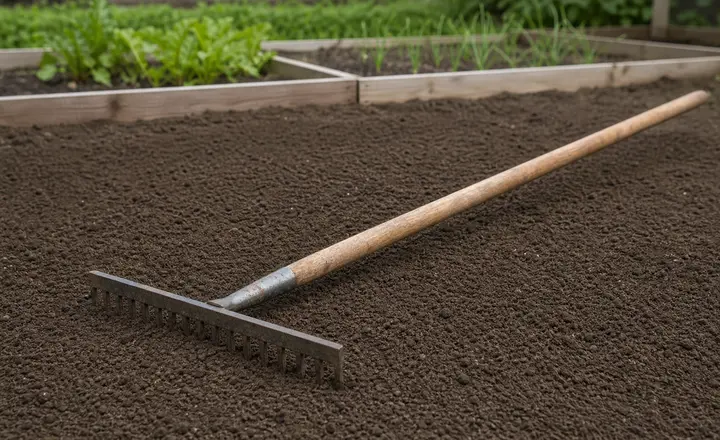
Distinguish soil rakes from leaf rakes
A garden or soil rake has a rigid head with short metal teeth. It breaks small clods, moves a shallow layer of soil and levels a prepared bed. A spring-tine or fan-shaped leaf rake flexes around plants and gathers leaves or light debris; it is not built to cultivate dense ground.
Choose a head narrow enough to pass between bed edges and existing crops. A wide head covers open ground faster, while a smaller head is easier to control in raised beds. Inspect the connection between head and shaft because repeated push-pull work can loosen a weak joint.
Look for balance and a useful reverse edge
The shaft should allow an upright, relaxed stance with both hands spaced comfortably. Lift and turn the rake to check that the head does not feel unwieldy. A straight upper edge on the back of the head is useful for final levelling and gently firming loose ridges.
Steel teeth tolerate regular soil work; lighter materials may suit fine prepared beds but should not be forced through stones or compacted clods. The teeth should be even, firmly attached and free of bends that make the rake track to one side.
Prepare soil only when it will crumble
Do the heavy loosening first with a suitable fork or other method. When a handful of soil breaks apart under light pressure rather than smearing, pull the rake toward you in short overlapping passes. Remove stones and persistent roots as they appear rather than repeatedly dragging them across the bed.
For direct sowing, aim for a level, crumbly surface supported by firmer soil underneath. Excessive raking can separate soil particles, destroy aggregates and create a surface that caps after rain. Use the back of the rake for the final pass and check that water will not collect in hollows.
Store the head safely
Clear soil from between the teeth and dry metal parts before storage. Straighten only minor bends when the material permits; cracked or severely deformed heads should be replaced. Tighten or repair a loose head before it detaches during use.
Hang the rake with the teeth against a wall or otherwise out of a walkway. Never leave it on the ground with the teeth pointing upward, where stepping on the head can drive the shaft upward.