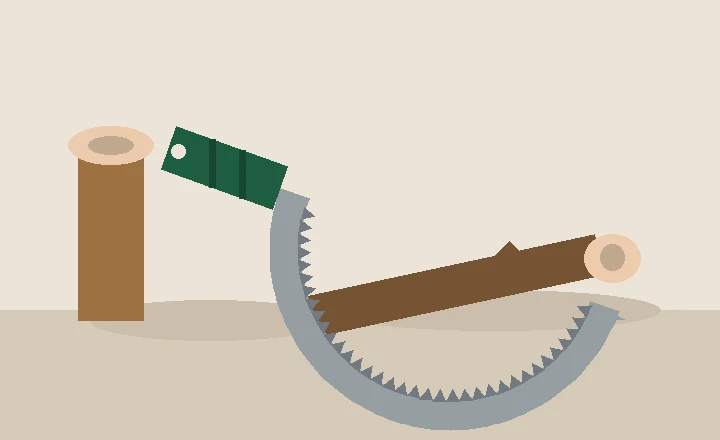
Know when a saw is the right tool
The RHS tree pruning guide draws the dividing line at about 2.5 cm (1 in): stems below that work well with secateurs or loppers, while thicker branches should be sawn through completely rather than left as stubs. In practice, a pruning saw is the tool of choice once branches approach 5 cm (2 in) in diameter and beyond, and it is the last hand tool you reach for before larger power equipment.
A dedicated pruning saw is also better than a carpenter's saw: the teeth are set for a wider kerf that lets sawdust escape, so the blade cuts faster and binds less in green wood. If a branch does not cut with a steady, controlled pull, it is beyond the saw's comfortable capacity, so stop and split the job into smaller sections rather than forcing it.
Choose bypass or anvil action
Bypass pruning saws have a gently curved blade with a hook at the tip. The hook wraps the underside of the branch and the teeth cut on the pull stroke, which keeps the cut controlled and suits live wood, including work above the head where the blade can be pushed down and drawn through. Anvil saws use a straighter blade with a blunt end that bears against the branch; they suit dead, brittle wood where a clean scissor-like cut matters less than simple, reliable leverage.
As with secateurs, keep the cutting blade working in the direction it was designed for. A bypass saw forced around a branch it cannot wrap will wander and can tear the bark, while a dry, dead limb is exactly the job an anvil blade tolerates.
Match blade length and build to the job
As a rule of thumb, the longer the blade, the thicker the wood it can cut. Compact folding saws with blades around 20 cm fit in a pocket and handle shrub and light tree work. Blades of roughly 30 cm are the all-round choice for hedging, fruit trees and ornamentals. Long, fixed curved or straight blades of 45–50 cm give the reach and stroke length for large trees, and the RHS lists a long-handled pruning saw among the kit for serious tree work.
Whatever the length, check the build: a non-slip grip that stays secure when you lean into the stroke, a positive lock or sheath so the blade is always sheathed when carried, and a replaceable blade if you expect years of use. A folding saw should open and lock without any lateral play in the joint.
Make the cut cleanly
Start each cut at the base of the branch so the blade is fully engaged, then work in steady, full-length strokes, applying pressure on the cutting stroke and easing off otherwise. Let the teeth do the work; a saw that stalls is a sign of dull teeth or wood beyond capacity, not a reason to muscle it. A ragged, crushed cut closes more slowly than a clean one and can invite decay into the plant.
For larger limbs, follow the undercut and overcut method the RHS recommends: make a shallow cut into the underside of the branch about 20 cm (8 in) out from where the final cut will be, then a shallow cut into the top about 2.5 cm (1 in) further along, and saw through to remove that section. Finish by cutting the stub just outside the branch collar, holding it to take its weight. Do not cut flush to the trunk — the collar is the tree's protective zone where healing takes place — and the RHS no longer recommends wound paints in most cases, as they can inhibit healing and encourage rot.
Work within your limits
Pruning saws concentrate force in a single hand, so set up the job before you start: stable footing or a well-placed ladder, a clear drop zone below the cut, and awareness of overhead electrical conductors. The RHS tool list for tree work includes gloves, safety goggles and head protection for larger trees, and that is sensible proportion: chips and sap fly on the pull stroke.
Do not work above your head, and be honest about the weight of what you are releasing. Heavy limbs may need to be lowered with ropes, removed in sections, or left to a qualified arborist. A branch that fails in an unexpected direction is a serious injury, so when in doubt, cut it down in stages.
Keep the saw clean and sharp
Brush off sawdust after each session, wash away sap with soapy water and dry the blade before storage; dried resin gums the teeth. When you have been working with diseased wood, disinfect the blade between affected and healthy plants, as the RHS advises, using a product and contact time suitable for pruning tools.
Sharpen only the bevelled cutting edge, following the existing tooth angle with a fine file or diamond sharpener, and remove the smallest amount of metal that restores the bite. When the blade is nicked, twisted or worn beyond adjustment, replace it rather than forcing a dull saw. Store the saw in its sheath or with the lock engaged, where children and curious pets cannot reach the teeth.
Sources and review basis
- How to prune a tree — Royal Horticultural Society
- Best pruning saws to buy in 2026 — BBC Gardeners' World Magazine
- Follow Proper Pruning Techniques — Texas A&M AgriLife Extension (Earth-Kind)
- Trees: Reducing Size Safely — Royal Horticultural Society
The 2.5 cm hand-tool/saw threshold, undercut and overcut method, branch-collar guidance, disinfection tip and equipment list follow the RHS. Blade action, blade-length ranges and the 5 cm working diameter follow the BBC Gardeners' World pruning saw reviews, and the pull-stroke kerf behaviour of pruning saws follows Texas A&M AgriLife Extension. Manufacturer instructions for a specific saw, the condition of the wood and your own access and strength take precedence over these general ranges.