Why soil temperature matters
Seeds germinate in the soil, not in the air. A mild spring day can sit above 15°C while the ground at sowing depth is still below 7°C, and sowing warm-season crops into cold soil wastes seed: germination is slow and uneven, and damp, cold soil encourages rot and damping-off before the seedling breaks the surface. As the soil warms, germination speeds up and becomes even, and roots grow more actively. For this reason, experienced growers time sensitive sowings by soil temperature rather than by the calendar or the air temperature alone.
Soil also warms and cools more slowly than air, so it lags the weather. Dark, fine soil in full sun warms faster than pale, stony or shaded ground, and a south-facing bed can be several degrees warmer than a north-facing one. A thermometer turns that guesswork into a number you can compare against what the crop needs.
How to take an accurate reading
Choose the measurement depth before you start. For a particular sowing, measure at the depth specified for that crop; for a standard garden-soil comparison, record a consistent depth such as 5 or 10 cm and label the reading accordingly. Insert enough of the probe to place its sensing area at that depth, then leave it in place until the display or pointer stops changing. Stabilisation time varies by instrument, so follow its instructions rather than assuming a dial or digital model will respond within a fixed number of seconds.
Take the reading in the same conditions you will sow in: the same bed, the same light or shade, and at a similar time of day. Check a couple of spots in the bed and use the lower reading, because you want the whole sowing area to be warm enough. Avoid measuring straight after rain, when the surface is chilled, or at midday on a hot dry day, when the top layer runs warmer than the seed will experience. If the reading is borderline, wait a day or two and measure again rather than sowing into cold soil.
Soil temperatures for common crops
These are working ranges for direct sowing; seed packets and extension guides vary slightly by cultivar, so treat them as a guide rather than a rule.
- Peas, spinach, lettuce — can germinate in soil around 5°C and above; sow as soon as the ground is workable.
- Carrots, onions, beetroot — germinate slowly below about 7°C; aim for 10°C or more for even results.
- Potatoes — plant seed potatoes when the soil is workable and around 7°C or above.
- Beans, sweet corn — want soil at 10°C or above; 15°C gives quick, even germination.
- Tomatoes — 10°C is a bare minimum for outdoor sowing; 15 to 21°C is the comfortable range.
- Peppers, aubergines, courgettes and squash — warm-season crops that want soil at 16 to 18°C or above; these are the sowings a thermometer pays for most.
Dial versus digital
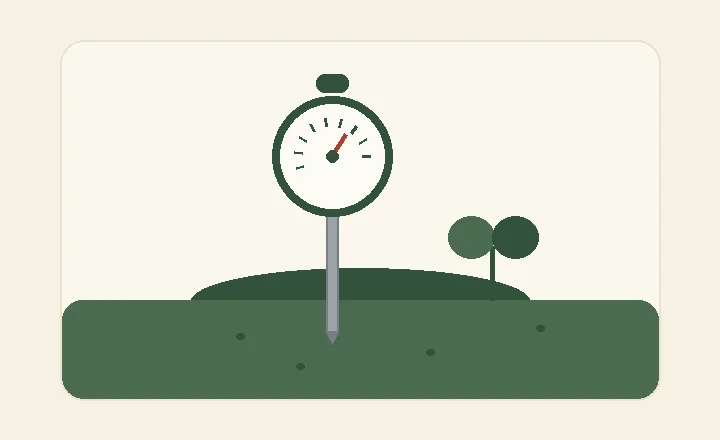
A dial (bimetallic) soil thermometer is a long steel probe with a round face on top. It needs no batteries, survives being dropped into a bed, and is accurate enough for sowing decisions; read it at eye level and wait for the needle to settle. A digital probe gives a number you can note down and compare between beds, and many have a maximum-hold function, but the probe tip is the part that fails, so keep an eye on the battery and replace the unit if readings drift. For most gardeners a sturdy dial thermometer is the better first buy; a digital one is worth having if you run several beds, a polytunnel and a cold frame and want to compare them.
When a thermometer won't solve the problem
A soil thermometer tells you the ground is not ready; it cannot make it ready. If the soil is too cold for the crop you want to sow, either choose a crop that tolerates cool soil, or warm the ground: a cloche, cold frame or layer of horticultural fleece raises soil temperature, and dark mulch or black plastic warms bare beds in spring. An air thermometer or a weather forecast is not a substitute, because the air can be warm while the soil stays cold. And do not chase a warm reading by sowing into waterlogged ground just because the number looks right — workable, well-drained soil matters as much as temperature.
Care and maintenance
Knock soil off the probe and wipe it clean after use; grit packed around a dial's stem can freeze the needle. Store the thermometer under cover, probe up, where it will not be knocked or stepped on. For digital units, keep the battery fresh and check the reading occasionally against a known reference, such as a calibrated kitchen thermometer in a bucket of water at a measured temperature. Retire the tool if the probe is bent, the dial sticks, or the digital reading no longer tracks the dial.
Sources and review basis
- University of Minnesota Extension, soil temperature and planting — basis for the sowing temperature ranges and the guidance to measure at sowing depth.
- Royal Horticultural Society, vegetable growing advice — general context for timing sowings to soil conditions and using cloches and frames to warm the ground.
The temperature ranges follow the conservative values given in horticultural extension guidance for direct sowing; cultivars and local climates vary, so treat them as a starting point and confirm against the seed packet. This page was reviewed against those sources and the site's tool-reference conventions in August 2026.