Quick answer
Start Brussels sprouts early enough to complete their long season in cool autumn or winter weather. Grow sturdy young plants, set them into fertile moisture-retentive soil at wide spacing and firm the root zone well. Protect seedlings from brassica pests and keep water steady through summer.
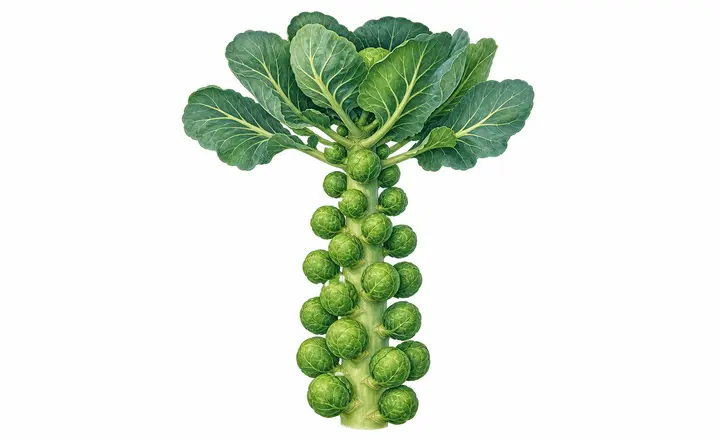
Sprouts form upward from the base of the main stem. Pick them while tight and firm, beginning with the lowest. Tall plants occupy ground for many months, so choose Brussels sprouts only where their winter harvest justifies the space.
Choose for season, size and resistance
Early, mid-season and late cultivars mature at different times. Select from the intended harvest window backward rather than buying seed solely for sprout size. Compact varieties fit smaller or exposed gardens; tall varieties need shelter or support.
Look for current resistance to clubroot or other locally important diseases where available. Resistance is specific and does not replace rotation, clean transplants and suitable soil. Green and purple sprouts grow similarly, although colour and cooking qualities vary.
The RHS Brussels sprouts guide describes a slow-growing hardy crop, commonly reaching about 90cm and harvested from autumn into winter.
Site and soil
Use full sun and a sheltered site with deep, fertile soil that drains while holding useful moisture. A tested pH around 6.0–7.0 is suitable; where soil is more acidic, follow a soil-test recommendation rather than applying lime by habit. Clubroot risk makes pH and drainage especially important.
Prepare organic matter well before planting so the surface can settle. Brassicas stand better in firm soil than in a loose freshly filled bed. Do not grow them in a site with a known recent brassica disease problem simply because another family member was harvested early.
Sow and transplant
Use the cultivar's days to maturity and local cool-season window to choose a sowing date. In cool climates, sow in modules or a protected seedbed in spring. Warmer regions may sow later for a winter crop. Give indoor seedlings strong overhead light and do not use unnecessary heat after emergence.
Harden plants and transplant when they have a strong root system, preserving the plug. Space most cultivars about 60–75cm apart. Plant at the previous depth, firm soil around the root ball and water thoroughly. Loose planting encourages wind rock, which damages new roots and reduces stability.
Containers and small gardens
One compact plant can grow in a container at least 30cm wide with sufficient depth and volume, but it needs reliable water, feeding and support for a long season. A pot can help where clubroot affects garden soil only if clean growing media and hygiene prevent recontamination.
Compare the container's many occupied months with quicker crops. Brussels sprouts are rarely an efficient choice for a tiny balcony unless they are a high-priority harvest.
Water, feed and support
Maintain even soil moisture, particularly while plants establish and sprouts swell. Mulch established plants with a clean material to reduce evaporation, leaving the stem clear. Use soil-test results and crop response for feeding; excessive nitrogen can create soft leaf growth and delay firm sprouts.
Earth up or stake plants where wind threatens them, without driving a support through major roots. Remove only yellow or damaged lower leaves unless the chosen cultivation method directs otherwise. Topping is sometimes used to concentrate maturity, but timing is cultivar- and climate-dependent and can reduce the continuing harvest if done too soon.
Protecting and diagnosing the crop
| Symptom | Likely causes to investigate | First checks |
|---|---|---|
| Plant rocks or leans | Loose soil, wind or root damage | Firmness, support and root anchorage |
| Sprouts remain loose | Heat, drought, excess nitrogen or cultivar | Maturity window, moisture and feeding |
| Roots are swollen and plant stunted | Possible clubroot | Crop history, drainage and root shape |
| Leaves have large irregular holes | Caterpillars, slugs or birds | Leaf undersides, droppings and damage height |
| Sprouts contain colonies of insects | Aphids or other sap feeders | Inner sprout leaves and natural enemies |
| Lower leaves yellow | Normal ageing, water stress or disease | Pattern, soil moisture and lesions |
Use fine mesh where locally appropriate, installed before pests arrive and secured so wildlife cannot enter. Rotate brassicas and diagnose disease before disposing of residues or treating the bed.
Harvest and handling
Start at the base when sprouts are firm, tightly closed and the useful size for the cultivar. Twist or cut a few at a time and remove the associated yellowing leaf. Continue upward as later sprouts mature; some modern cultivars allow a whole-stem harvest.
After the sprouts, tender tops may be harvested where healthy and appropriate. Cool harvested sprouts promptly and inspect for insects before storage. Record cultivar, transplant date, first and last harvest and whether plants remained stable through wind.
Sources and review basis
- How to grow Brussels sprouts — Royal Horticultural Society
- Growing Brussels sprouts in home gardens — University of Minnesota Extension
Local temperature patterns determine whether the crop is scheduled for autumn or winter. Follow locally current pest, disease and crop-rotation advice.