Quick answer
Grow common chives (Allium schoenoprasum) in sun or light partial shade, in fertile soil that stays moderately moist without becoming waterlogged. Start with a potted plant or division for the quickest crop, or sow seed in spring. Space clumps 15–30cm apart, water while they establish and keep pots evenly moist during active growth.
Snip leaves close to the base from late spring into autumn. Remove finished flower stalks to prevent unwanted seedlings, or cut a tired clump to about 5cm after flowering to encourage fresh leaves. Divide congested plants every three or four years.
What determines success
Strong light produces dense leaves and plenty of flowers. Chives tolerate partial shade, but aim for at least four hours of direct sun and preferably six or more. The University of Minnesota Extension chive guide recommends six to eight hours for best growth while recognising tolerance of light shade.
The ideal root zone is moisture-retentive, rich in organic matter and well drained. A tested pH of 6.0–7.0 is a useful target. Chives cope with more moisture than Mediterranean herbs such as rosemary, but standing water excludes air from their roots and can rot the base. Improve the wider bed or use a raised area rather than planting into a small amended pocket in persistently wet ground.
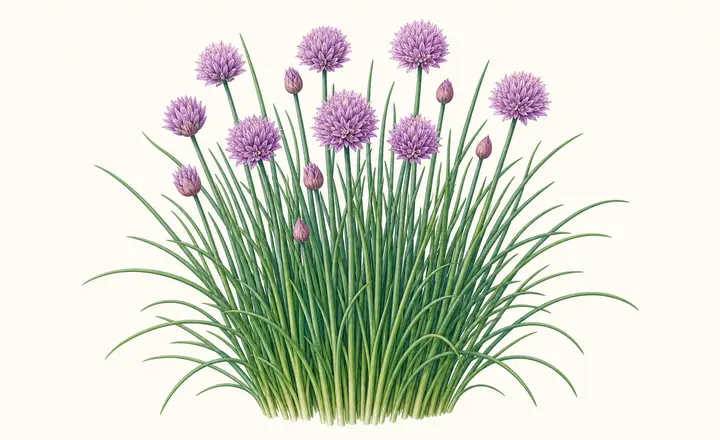
Check the name when buying seed or plants. Common chives have fine, hollow, cylindrical leaves and mauve flower heads. Garlic chives (Allium tuberosum) have flatter leaves, white flowers and a garlic flavour, so their size and seasonal behaviour are not identical. Kew's Plants of the World Online record accepts Allium schoenoprasum in the Amaryllidaceae family.
Start from seed, plants or division
A young potted plant gives the fastest route to repeated harvests. Inspect it for healthy green growth, a firm base and roots that do not smell sour. A crowded pot can be separated into several substantial pieces, but very small fragments take longer to establish.
For seed, sow a few seeds together in modules indoors in early spring, 0.5–1cm deep in a free-draining seed compost. Keep the medium slightly moist and provide bright light after germination. Harden the seedlings off before moving them outside. Direct sowing is also possible in prepared ground or a container in spring; thin or transplant the resulting clusters rather than leaving a dense mat.
Division preserves the parent plant and is the simplest way to renew an established clump. Lift in spring or autumn, separate it into several rooted sections and replant promptly at the original depth. The RHS chive guide recommends dividing every three or four years so the centre does not become congested and weak.
Plant in the ground or a container
Set clumps 15–30cm apart. The closer end makes a quick edible edging; the wider end allows mature plants more room and makes division less urgent. Keep the crown at the same level it was growing previously, firm gently and water thoroughly. Chives do not need support.
For one lasting clump, use a container at least 20cm wide and deep, holding about 5 litres or more, with unobstructed drainage holes. Fill it with a peat-free, loam-based potting mix and leave space below the rim for watering. Larger planters can hold several clumps at the same spacing used in the ground.
A small kitchen windowsill pot is useful for short-term picking, but low winter light limits regrowth. For a longer season, lift and pot a division, give it the brightest cool indoor position available and expect slower growth than outdoors.
Water, feed and maintain growth
Water new plants during dry spells through their first growing season. Once established in open ground, chives generally need extra water only in prolonged dry weather. Container compost dries much faster: check below the surface and water thoroughly when it begins to dry, then let surplus water escape.
Garden compost used as a light late-winter or early-spring mulch can add organic matter, conserve moisture and suppress weeds. Keep it around rather than packed over the crown. Base fertiliser decisions on a soil test where possible; chives have modest nutrient needs, and heavy feeding can create soft growth without correcting shade, root crowding or poor drainage.
Container nutrients eventually wash out. If an established potted clump grows weakly despite good light, moisture and root space, use a modest feed labelled for edible container plants at the product rate. Do not feed a waterlogged or dormant plant in an attempt to force recovery.
Flowering, cutting back and renewal
Round mauve flower heads appear in late spring and summer. Their individual florets are edible, and open flowers supply nectar to visiting insects. Flower stalks become firmer than the leaves, so harvest around them or remove them at the base once flowering finishes.
Deadheading limits self-seeding. Leave selected heads only if seedlings are wanted, remembering that named cultivars may not come true from seed. When the whole clump looks coarse after flowering, cut all foliage to about 5cm and water if the soil is dry; fresh leaves should follow under suitable growing conditions.
Remove dead foliage before new spring growth becomes tangled through it. If leaves remain sparse, roots circle the pot or the centre dies out, divide and replant healthy outer sections rather than compensating with more fertiliser.
Diagnose common problems
| Symptom | Likely causes to investigate | First checks |
|---|---|---|
| Leaves are pale and thin | Shade, crowded roots, exhausted container mix or excess water | Direct sun, drainage and root space |
| Tips brown during active growth | Dry root zone, hot reflected conditions or excess soluble fertiliser | Moisture below the surface and feeding history |
| Base is yellow, soft or foul-smelling | Waterlogging or root/crown rot | Drainage holes, standing water and root condition |
| Bright orange raised spots appear | Leek rust | Both leaf surfaces, nearby alliums and airflow |
| New leaves are curled or sticky | Aphids | Shoot bases and folds in young leaves |
| Few new leaves follow repeated cutting | Overharvest, drought, dormancy or congestion | Season, soil moisture and time since division |
Remove badly rotted material and do not move suspect divisions into clean pots. Improve airflow, avoid wetting foliage unnecessarily and clear dead allium leaves where disease persists. Confirm the problem before treatment; if control is needed, use only a product whose current label permits use on edible herbs and follow regional guidance.
Harvest, storage and end-of-season care
Harvest when leaves are long enough to use without stripping a small, newly planted clump. With clean scissors, cut leaves just above the base rather than clipping only the tips; take from different parts of the plant so enough foliage remains for recovery. Pick newly opened flower heads if wanted, ensuring the plant has not been treated with a product unsuitable for edible flowers.
Chives have their best texture and flavour fresh. Use cut leaves promptly or freeze clean, chopped leaves in small portions; freezing preserves their usefulness better than trying to keep a large cut bunch for weeks. Add them near the end of cooking because prolonged heat reduces their fresh onion character.
Outdoor foliage usually declines as light and temperature fall. Stop forcing harvest from a weak clump, remove dead growth in late winter and let the roots resume naturally in spring. Protect containers from standing in winter water, but do not assume this hardy perennial needs a warm room.
Sources and review basis
- How to grow chives — Royal Horticultural Society
- Growing chives in home gardens — University of Minnesota Extension
- Allium schoenoprasum — Plants of the World Online, Royal Botanic Gardens, Kew
Sowing, harvest and dieback shift with local climate, exposure and whether the plant is under cover. Treat the UK harvest range as typical, then use active growth and leaf condition to decide when to cut.