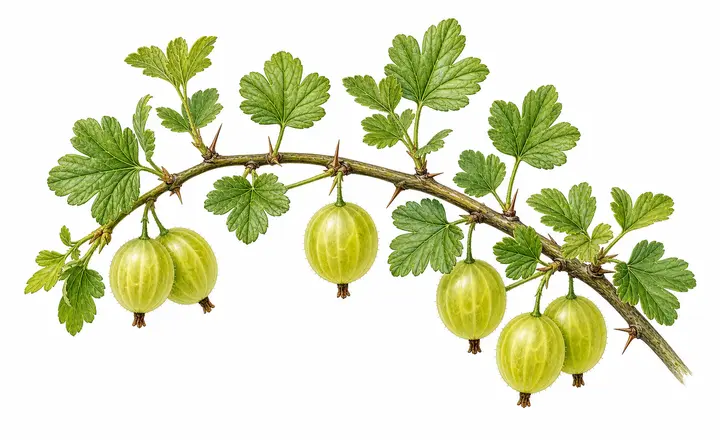
Quick answer
Plant a named gooseberry cultivar in sun or light shade, in moist but freely draining soil, with enough room to keep the thorny framework open. A single plant will usually set fruit because gooseberries are self-fertile. Sun gives the heaviest, sweetest crop; light shade is useful where the site would otherwise become hot and dry.
Space ordinary bushes 1.2–1.5m apart, water during establishment and while fruit swells, and protect flowers from late frost and ripening berries from birds where necessary. Prune while dormant to remove damaged, low and ageing wood without stripping out all the productive young framework. Green fruit can be picked for cooking in June; leave the remainder to colour and soften in July or August.
Choose the cultivar and form
Dessert cultivars are selected for sweet ripe fruit, while culinary cultivars can be picked firm and tart for cooking. Fruit may ripen green, yellow, pink or red. Check the nursery description for mature size, flavour, season, thorniness and resistance to powdery mildew rather than choosing by berry colour alone.
The usual form is an open-centred bush about 1–1.5m high and wide. A cordon trained to wires uses much less ground space, while a fan can cover a wall or fence. A standard has a bushy head on a tall grafted stem and needs permanent staking. The RHS pruning guide explains how the pruning differs between these forms.
Most cultivars are self-fertile, so one bush is enough for fruit set. Another cultivar may improve yield or spread the harvest, but is not a requirement. Outside the UK, check local rules before buying a Ribes plant because restrictions intended to protect white pines still apply in some regions.
Conditions that determine success
Choose a sheltered position with useful airflow. Gooseberry stems can snap in strong wind when loaded with fruit, while a stagnant, congested site favours mildew. Avoid a frost pocket because the dormant shrub is hardy but its spring flowers can be damaged by late frost.
Full sun produces the largest and sweetest crop, although light or dappled shade is tolerated. The soil should hold moisture without remaining saturated. Remove perennial weeds before planting and keep grass away from the root zone.
A soil pH around 5.6–6.5 is a useful target from Oregon State University Extension, but gooseberries tolerate a wider range, including mildly alkaline soil. Test before trying to change pH and base amendments on the result rather than routinely adding acidifiers or lime.
Buy, propagate and plant
Buy a healthy one- or two-year-old bush or a correctly trained cordon from a reputable nursery. Dormant bare-root plants are normally available from late autumn to early spring; container-grown plants can be planted more widely through the year if the soil is neither frozen, waterlogged nor parched and reliable watering is possible.
Keep bare roots cool and damp before planting. Set the plant at its previous soil mark, spread the roots without bending them sharply, firm gently and water thoroughly. Allow 1.2–1.5m between bushes or standards. Single cordons can be 30–38cm apart, but they need their own permanent upright support; do not use cordon spacing for free-standing bushes.
Seedlings will vary and will not reliably reproduce a named cultivar. For home propagation, take about 30cm hardwood cuttings from a young, healthy plant during dormancy and root them in a prepared trench or pots of suitable cutting medium, as described in the RHS gooseberry growing guide. Do not propagate a bush with unexplained decline, persistent dieback or virus-like symptoms.
Containers and supports
Grow one compact bush, cordon or standard in a stable container at least 40cm wide and deep—typically about 30 litres or more—with several unobstructed drainage holes. Use a durable peat-free, soil-based growing medium. Dimensions and stability matter more than the nominal litre figure, especially for a top-heavy standard.
Keep a standard tied to a strong stake and give a cordon or fan permanent wires and soft ties. Do not rely on the pot rim as support. Check moisture frequently, top-dress with fresh medium between repotting years and move up in size before roots become severely congested.
Water, mulch and feed
Water new bushes during dry spells for their first two growing seasons. Established plants in open ground often need less irrigation, but check moisture while flowers and fruit are developing and during prolonged drought. Container plants need an even moisture supply throughout the growing season; water thoroughly, then let surplus drain instead of leaving the container standing in water.
Apply an organic mulch in spring to conserve moisture and suppress weeds, leaving the stem base clear. In reasonably fertile, regularly mulched ground, extra fertiliser may not be needed. Use a soil test and plant growth to diagnose a deficiency before feeding.
Container plants exhaust nutrients more quickly. Follow the growing-medium or fertiliser label and use a feed intended for fruiting plants where needed. Excess nitrogen makes soft, crowded growth more vulnerable to mildew and is not a remedy for poor fruiting caused by shade, frost or drought.
Flowering, fruit development and protection
Small self-fertile flowers open in spring on spurs and near the base of shoots made the previous year. If frost is forecast during bloom, cover the bush overnight with supported horticultural fleece and remove it during the day so pollinating insects can reach the flowers.
Keep moisture steady while berries swell. Wildlife-safe netting or a fruit cage may be needed before fruit colours; keep mesh taut, secure every edge and inspect it regularly so birds and mammals cannot become trapped. Remove temporary netting promptly after harvest.
Prune an open, productive framework
Wear thorn-resistant gloves and eye protection. In late winter or early spring, before growth starts, remove dead, damaged, diseased and crossing growth. Keep the centre open, clear the short main stem and remove low branches that will touch the soil once fruit weighs them down.
An established bush can carry roughly eight to ten well-spaced main branches. Each year or two, remove one to three of the oldest, least productive branches at the base or back to a strong replacement side-shoot. This gradual renewal preserves a mix of fruiting ages; severe indiscriminate cutting can remove the spurs and one-year-old bases that carry the crop.
Optional summer spur pruning trades some crop number for larger, easier-to-pick berries. In mid-June to July, shorten current-season side-shoots from the main branches to about five leaves, but retain strong shoots needed to replace old branches. Cordons, fans and standards have form-specific cuts, so follow a training guide rather than applying bush instructions unchanged.
Common-problem diagnosis
| Symptom | Likely causes to investigate | First checks |
|---|---|---|
| Leaves are rapidly stripped, often from the centre upward | Gooseberry sawfly larvae | Inspect low inner leaves and undersides from April for pale green, black-spotted larvae; remove by hand where practical |
| White powder on young shoots or fruit later turns brown | Gooseberry mildew | Check crowding, airflow, soft nitrogen-rich growth and cultivar susceptibility; remove affected shoot tips |
| Brown spots followed by early leaf fall | Currant and gooseberry leaf spot | Inspect both leaf surfaces, collect fallen infected leaves and confirm the diagnosis before treatment |
| Flowers brown and few berries form | Late frost, shade, a young plant or removal of fruiting wood | Review minimum temperatures, sun, plant age and the last pruning cuts |
| Fruit remains small, shrivels or drops | Drought, root stress, overcropping or disease | Check moisture below the mulch, drainage, roots and fruit for mildew or damage |
| Berries disappear or are pecked as they colour | Birds or mammals | Check damage timing and the security and wildlife safety of the cage or net |
The RHS gooseberry sawfly guide recommends regular inspection and hand removal where practical, while recognising sawflies as part of garden biodiversity. Do not spray unidentified larvae. For mildew, begin with resistant cultivars, an open canopy, sensible feeding and removal of affected growth; follow current local guidance and product labels if any plant-protection product is considered.
Harvest, store and finish the season
For cooking, make an early pick in June while berries are still green and firm, taking alternate fruit so those left behind have space to enlarge. For fresh eating, wait until the cultivar reaches its mature colour, softens slightly and tastes sweet enough, usually in July or August. Pick with the stalk attached to reduce skin damage, and use gloves and long sleeves around thorny branches.
Place ripe berries in shallow containers and cool them promptly. Refrigerate dry, sound fruit in a covered container, checking it regularly; wash only before use. Freeze sound berries or use a tested preservation recipe for jams and bottled products.
After leaf fall, remove diseased leaves and mummified fruit and check ties, wires, stakes and guards. Record the cultivar, flowering frost, pruning method, first harvest and any sawfly or mildew symptoms. Use that record to time winter renewal pruning and improve protection the following year.
Sources and review basis
- How to grow gooseberries — Royal Horticultural Society
- Gooseberries: pruning and training — Royal Horticultural Society
- Growing currants and gooseberries in the home garden — University of Minnesota Extension
- Growing berries on the Oregon Coast — Oregon State University Extension
- Ribes uva-crispa — Kew Plants of the World Online
Cultivar vigour, mildew resistance and harvest timing vary. Confirm local restrictions and disease advice outside the UK, use measured soil conditions, and follow the nursery description for the named cultivar.