Quick answer
Grow horseradish from healthy root cuttings planted in spring. Give it sun, deep soil that drains well and space you can inspect for regrowth. A large container is the simplest choice where spreading roots would be unwelcome. Keep growth steady through summer and harvest useful roots during autumn dormancy.
Decide whether you want a permanent clump or an annually lifted root crop before planting. A young perennial clump needs time to establish; a first-autumn harvest is possible with vigorous plants and a sufficiently long season, but is not guaranteed.
Identify the crop and choose planting material
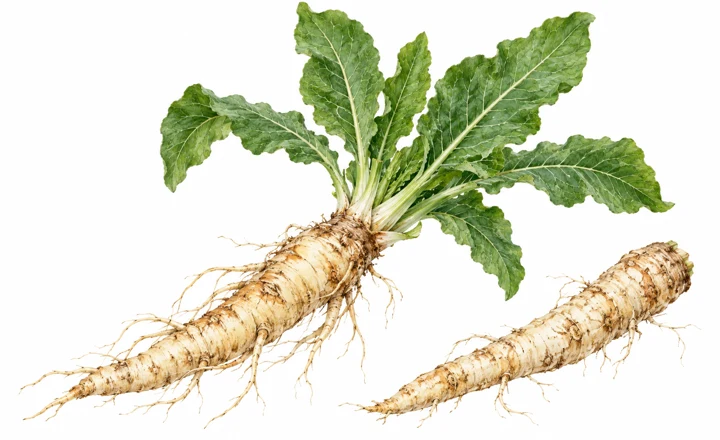
Horseradish, Armoracia rusticana, belongs to the cabbage family, Brassicaceae. It forms broad, wavy leaves above pungent pale roots. It is a different plant from true wasabi. Wisconsin Extension's botanical profile describes ordinary green-leaved plants and the cream-marked ornamental cultivar ‘Variegata’.
Buy named, healthy planting stock or obtain roots from a known healthy clump. For cooking, prioritise root quality over decorative foliage. Label purchased cuttings so you retain their orientation; do not use unidentified wild roots. If you want a small crop that vacates the bed quickly, compare radishes before committing space to horseradish.
Match the site to your conditions
Choose a bright position with deep, workable soil. Utah State University Extension recommends pH 6.0–7.5 and soil-test-led fertilising. Correct drainage before adding nutrients. Too much nitrogen encourages leafy growth and branching, while drought stress can leave woody roots.
The quick-reference sun figures are planning estimates for partial shade and a sunnier preferred site. Its 20-litre container allowance is a practical starting point for one plant; depth matters as much as capacity. The 0°C planting figure means unfrozen, workable conditions for dormant roots, not a measured growth threshold or advice to plant into icy mud.
| Your situation | Practical choice | Main commitment |
|---|---|---|
| Small patio or mixed herb garden | One plant in a deep pot | Monitor moisture and escaping roots |
| Dedicated vegetable bed | Spaced root cuttings, lifted annually | Thorough harvest and regrowth checks |
| A permanent patch is acceptable | Maintain a perennial clump | Keep access around its boundary |
| Shallow, stony or winter-wet ground | Use a suitable container | Provide drainage and sufficient root depth |
Plant root cuttings or a young plant
Plant dormant cuttings in early spring when the soil can be worked. For a bed crop, University of Minnesota Extension recommends about 30cm between sets, placed vertically or at an angle with 5–8cm of soil above them. Keep the original upper end uppermost. Prepare the soil deeply and avoid fresh manure, which encourages forked roots.
For a pot, the RHS growing guide specifies at least 30cm width and depth, peat-free compost and roots covered by about 5cm of compost. Choose drainage holes and plant one young plant centrally, retaining its nursery soil level. Water after planting. Put the pot where you can lift and inspect it: drainage holes should remain open, but roots must not quietly establish in soil underneath.
Water, feed and manage summer growth
Check moisture below the surface before watering. Water thoroughly when needed, then let excess drain; do not leave a pot standing in water. Container plants require closer attention in drying weather. Use a general-purpose container feed according to its label. Avoid treating slow growth as automatic evidence of nitrogen deficiency.
Weed carefully while plants are small and mulch to reduce competition and moisture loss. For smoother roots in an annual bed crop, Minnesota describes optional lifting and stripping: expose the upper root, retain the strongest leafy crown, remove small upper side roots, then replace the soil without disturbing the lower roots. This is a quality-improvement technique, not essential maintenance for a casual perennial clump.
Keep horseradish contained
Small root remnants can regenerate. Do not cultivate through an unwanted patch and scatter fragments. When removing plants, work methodically around the clump and revisit the area for new shoots. Keep root-bearing soil separate from soil destined for other beds.
For a contained perennial pot, plan an annual inspection and root harvest. RHS advice is to let young plants establish until their second autumn, then remove no more than half the roots and repot the remainder in fresh compost. Cutting foliage alone does not remove the underground plant.
Diagnose common problems
| Symptom | What to investigate | First response |
|---|---|---|
| Leaves flop | Dry compost or damaged, waterlogged roots | Check moisture before adding water |
| Roots are soft or decaying | Poor drainage or excessive watering | Discard rotten material and correct drainage |
| Many small holes in leaves | Flea beetles or feeding caterpillars | Inspect leaves and identify the pest |
| Plenty of leaves, disappointing roots | Excess nitrogen, branching or an immature crop | Review feeding and harvest timing |
| Shoots appear beyond the planting area | Roots left behind or escaped from a pot | Trace and remove the connected root |
Wisconsin identifies flea beetles and cabbageworm larvae as possible leaf pests. Photograph unfamiliar damage and seek local identification before choosing a treatment; a hole in a leaf does not by itself justify spraying.
Harvest, store and use the roots
For an annual crop, Utah State describes first-year harvesting where the growing season is long enough. Leave weak plants to develop rather than stripping them on a calendar date. Iowa State's harvest guidance notes substantial late-season root growth: its October–November recommendation is regional, so use local autumn conditions and soil workability. In the UK, autumn into early winter is the main window; overwintered roots offer an early-spring alternative.
Loosen soil alongside the roots before lifting. Trim foliage to roughly 2.5cm above the crown. Keep sound whole roots cool, humid and dark; Iowa State gives 0–4°C for storage. Inspect stored roots and discard any that become soft or mouldy. Reserve healthy side roots separately for replanting, marking their upper ends.
Wash and peel only what you need. Grating releases pungent compounds that can make eyes water, so work with ventilation and keep your face away from the grater or processor. Prepare small amounts promptly for a recipe; a fresh sauce is not automatically a shelf-stable preserve.
Sources and review basis
- How to grow horseradish — Royal Horticultural Society: UK container culture and perennial harvest.
- Growing horseradish in home gardens — University of Minnesota Extension: bed planting and root management.
- How to grow horseradish in your garden — Utah State University Extension: soil, feeding, water and annual production.
- Horseradish, Armoracia rusticana — Wisconsin Extension: identity, spread, pests and preparation.
- When should I harvest horseradish? — Iowa State University Extension: harvest and storage.
Reviewed 23 September 2026. UK perennial guidance and US annual-crop methods are distinguished above. Local seasons, planting-stock instructions and soil-test results take precedence over broad planning values. Return to the plant guide directory to compare other crops.