Quick answer
Grow kohlrabi as a fast, cool-season brassica in sun, fertile soil and steady moisture. Sow outdoors from spring to midsummer once conditions are reliably mild, or start an early crop in modules. Thin or plant standard cultivars 15cm apart, protect the leaves from brassica pests and harvest the swollen stems at roughly golf-ball to tennis-ball size, before they become woody.
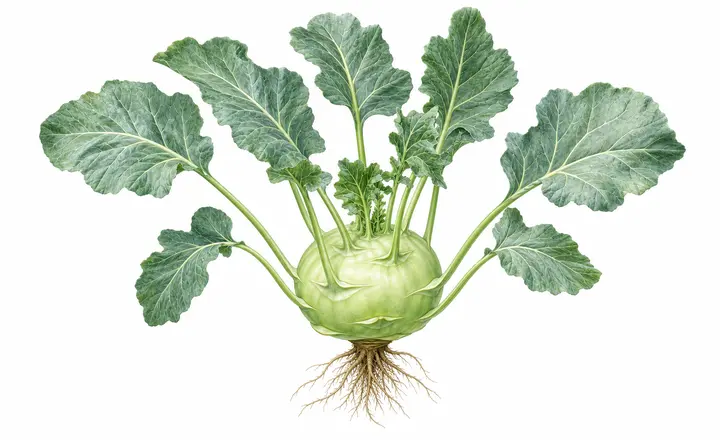
The rounded edible part is a stem that expands just above the soil, not a root. Do not earth it up. Green and purple cultivars have similarly pale flesh, and young leaves are edible as cooked greens.
Conditions that determine success
Rapid, uninterrupted growth produces the crispest kohlrabi. Cool weather suits it; prolonged cold while plants are young can trigger flowering later, while heat and drought can make the swollen stem tough. In hot or dry gardens, concentrate on spring and late-summer sowings instead of trying to force a crop through the hottest weeks.
Aim for at least six hours of direct sun. Some cultivars can manage about four hours or light afternoon shade, especially in summer, but deep shade slows swelling. Soil should drain freely while holding moisture, with plenty of mature organic matter. A pH around 6.0–7.5 is suitable according to the University of Minnesota Extension kohlrabi guide; test before adding lime or fertiliser.
Kohlrabi shares clubroot and several pests with cabbage, kale, broccoli, cauliflower, turnips and other brassicas. Rotate the group away from the same ground for about four years where space permits, and avoid carrying soil from a clubroot-affected bed into a clean one.
Choose a cultivar and sowing window
Standard green or purple cultivars are usually harvested young. Giant cultivars are bred to remain tender at a larger size, but need more time and space; do not assume an overgrown standard cultivar will behave like a giant one. Purple cultivars are often useful for later sowings because some are hardier.
The RHS kohlrabi guide recommends outdoor sowing from March to July, extending into August in places with mild autumns. Treat those as UK ranges rather than fixed dates. Wait for soil and air temperatures to settle above about 10°C, and use the seed supplier's maturity and hardiness information to place the cultivar in your local season.
Make several small sowings rather than one large row. This spreads the harvest and reduces the risk that every stem reaches its best size at once.
Sowing and transplanting
For direct sowing, make a drill about 1.5cm deep, water the base if it is dry and sow thinly. Space rows about 30cm apart. Once seedlings have their first true leaves, thin standard cultivars to 15cm. Remove surplus plants cleanly rather than leaving crowded clusters.
For an early crop, sow two seeds per small module in peat-free seed compost and retain the stronger seedling. Grow in bright, cool conditions. Harden plants gradually and set them out while still small—about 5cm tall—without disturbing the root ball. A badly checked or oversized transplant may stall or bolt rather than form a good stem.
Fine insect mesh can go over the bed immediately after sowing or planting. Seal the edges, allow enough height for leaf growth and inspect underneath for slugs and any pests trapped inside.
Spacing, ground and containers
Use 15cm between standard plants and about 30cm between rows. Give giant cultivars up to 30cm between plants, following their packet. Closer spacing limits airflow and bulb size; much wider spacing does not rescue a cultivar left past its tender stage.
In the ground or a raised bed, prepare a fine, firm surface and keep the shoulder of the swelling above soil level. Kohlrabi needs no mound, stake or other support.
For containers, the RHS recommends a pot at least 30cm wide and deep. That is roughly a 20-litre container depending on its shape. Allow no more than three standard plants at 15cm centres, or grow one plant where a larger moisture reserve is more important. Use fresh peat-free multipurpose compost and unobstructed drainage holes. Container crops need closer moisture checks than plants in open ground.
Watering, feeding and routine care
Keep the root zone evenly moist from germination to harvest. Water deeply enough to wet the compost or soil around the roots, then check it rather than watering by calendar. Repeated drying slows growth and promotes fibrous stems; waterlogging excludes air and can encourage root problems. A thin organic mulch after establishment helps reduce evaporation without burying the swelling.
Mature compost incorporated before sowing may supply much of a short crop's needs. Base additional feeding on a soil test, growth and the product label. If plants remain pale or slow after moisture, drainage and pH have been checked, use a suitable vegetable feed at its labelled rate. Excess nitrogen can produce abundant leaves without improving stem quality.
Hand-weed close to the plant because a hoe can cut the swollen stem or shallow roots. No pruning is needed. Remove only yellow, damaged or diseased leaves, and keep enough healthy foliage to power the swelling.
How the crop develops
After the leaf rosette establishes, the lower stem expands above ground. Check its diameter every few days as harvest approaches: quality can change quickly in warm, dry weather. A standard cultivar does not need to reach its theoretical maximum size.
A flower stalk rising from the centre means the plant is bolting. The stem usually stops improving and becomes coarse, so harvest any usable portion rather than trying to reverse the process. Cold stress when young, later heat, drought and over-maturity can all contribute. Kohlrabi is normally a biennial grown as an annual; support and flower pruning are irrelevant to a crop harvested for its swollen stem.
Protecting the crop
Use insect-proof mesh against cabbage butterflies and other flying brassica pests. Keep it clear of the foliage where practical and repair gaps. Flea beetles make many small shot holes, caterpillars make larger irregular holes, and slugs often rasp seedlings from the edges inward.
Rotation, clean seed, good drainage and removal of diseased crop debris are more useful preventives than routine spraying. If treatment is needed, identify the problem first and use only a product authorised for the crop and location, exactly as its current label directs.
Diagnosing common problems
| Symptom | Likely causes to investigate | First checks |
|---|---|---|
| Swollen stem is woody or bitter | Heat, drought, over-maturity or a standard cultivar left too large | Stem diameter, sowing date and moisture history |
| Plant flowers before swelling well | Prolonged chilling while young, heat or drought stress | Recent temperatures, hardening-off and watering |
| Large leaves but little swelling | Crowding, shade, excess nitrogen or damaged growing point | Spacing, daily light, feeding and plant centre |
| Many tiny round holes | Flea beetles | Young leaves and mesh gaps |
| Large irregular holes or skeletonised leaves | Caterpillars, slugs or pigeons | Leaf undersides, droppings and cover edges |
| Plant wilts although soil is moist | Clubroot, cabbage root fly or waterlogged roots | Root shape, larvae, drainage and brassica history |
| Stem cracks or becomes coarse | Uneven moisture or delayed harvest | Irrigation pattern and harvest size |
Harvest, storage and end of season
Harvest standard kohlrabi when the swollen stem is about 5–8cm across—roughly golf-ball to tennis-ball size—unless the cultivar description says otherwise. With repeated sowings, the typical UK harvest runs from May through November and can extend into December in mild areas. Cut the stem at ground level with a clean knife or lift the whole plant. Trim off the root and leaf stalks; keep sound young leaves for cooking.
Cool the harvest promptly. The University of Minnesota Extension advises that kohlrabi keeps its quality for about two weeks in a home refrigerator; commercial-style cold, very humid storage can hold it longer but is difficult to reproduce at home. Store leaves separately and use them first.
Remove bolted and badly diseased plants rather than composting material that could spread a persistent problem. After the last harvest, clear the mesh, record the cultivar and sowing dates, and move the next brassica crop to a different bed where possible.
Sources and review basis
- How to grow kohlrabi — Royal Horticultural Society
- Growing kohlrabi in home gardens — University of Minnesota Extension
- Growing kohlrabi in the home garden — Iowa State University Extension and Outreach
- German turnip: Brassica oleracea Kohlrabi Group — NC State Extension
These sources were reviewed on 28 July 2026. Local weather, soil-test results and the cultivar description should override broad calendar or feeding guidance.