Quick answer
Sow okra indoors with warmth in March or April, keep the seedlings in strong light, and move them to their final position only when the root zone is warm. In the UK, an unheated greenhouse or polytunnel is far more reliable than open ground. Give each plant full sun, fertile free-draining soil, steady moisture and enough room for air circulation. Pick the pods young and tender every few days.
Heat determines success. Okra may make attractive leaves and hibiscus-like flowers outdoors yet produce little if the season is cool or short. Choose an early or compact cultivar for a container or marginal climate, and regard an exposed outdoor crop as an experiment rather than a dependable harvest.
Choose a cultivar for the growing space
Okra cultivars differ in height, branching, pod colour, ribbing and the size at which pods remain tender. Green pods are most familiar, but red, burgundy and pale-podded cultivars are available. “Spineless” describes reduced prickles on the pods; the leaves and stems may still carry irritating hairs.
In a cool climate, prioritise early maturity and a compact habit. Taller cultivars need more greenhouse headroom and stronger support. Use the seed supplier's description for final spacing and harvest size rather than assuming every pod should reach the same length.
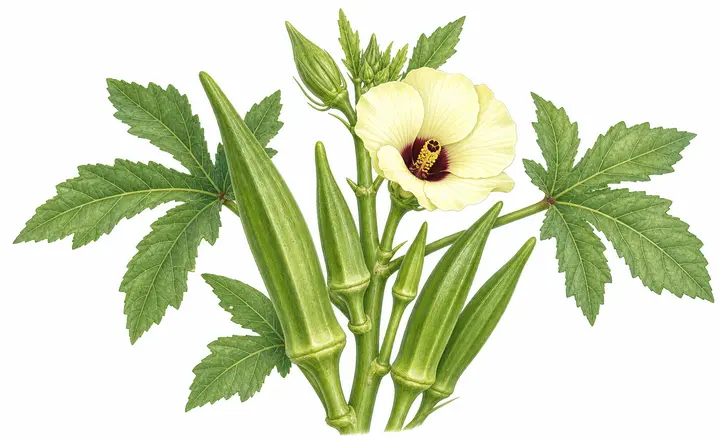
Okra is Abelmoschus esculentus, a member of the mallow family (Malvaceae), not a bean. The edible portion is an immature seed pod.
Heat, light and soil
Choose the sunniest sheltered position available, ideally with at least six hours of direct sun and closer to eight in summer. The RHS okra guide says that UK plants usually need a greenhouse or polytunnel, although a hot sheltered patio may crop in a long summer.
Use fertile, moisture-retentive but well-drained soil. A practical soil pH range is 5.8–6.8, based on the University of Georgia Extension home-garden guide. Improve light soil with mature compost; correct drainage rather than trying to compensate for waterlogging with less frequent watering.
Wait until the soil or container compost is reliably warm. The RHS plant profile uses 15°C soil as the threshold for outdoor planting, while warm-region extension guidance delays direct sowing below about 18°C. These are soil temperatures, not a promise that cool air will produce good pod set.
Sowing and raising plants
For UK conditions, sow indoors in March or April. Soak seeds in warm water for a couple of hours if desired, then sow one per small pot or deep module of moist peat-free seed compost. Keep the propagator above 16°C; warmer compost generally gives faster, more even emergence. Remove the cover as seedlings appear and move them immediately into bright light.
If more than one seedling emerges in a pot, retain the strongest rather than pulling tangled roots apart. Pot on before growth stalls, keeping plants warm and watering without saturating the compost. Okra dislikes cold, wet roots more than a brief wait in slightly dry compost.
In climates with a long hot season, direct sowing works once the soil is warm. Sow to the packet depth, keep the seedbed evenly moist through emergence, then thin rather than leaving competing plants together. Cold-soil sowing risks slow emergence and seedling disease.
Harden indoor-raised plants gradually before an outdoor move. A frost-free date alone is not enough: wait for warm soil and settled nights.
Planting in containers or the ground
For a container, allow one plant in at least 20 litres, approximately 30cm wide and deep. A larger pot buffers water and temperature swings and is preferable for a vigorous cultivar. Fill with fresh peat-free multi-purpose compost, plant at the previous depth and leave a small watering lip.
In a greenhouse border or warm outdoor bed, enrich the soil with mature compost and space plants 30–90cm apart according to cultivar. About 30–45cm suits compact forms; large, branching plants may need 60–90cm. Do not crowd plants merely to increase plant count—shading and restricted air movement work against flowering and pest checks.
Warm an outdoor bed under a cloche before planting if necessary, then remove or ventilate protection before heat builds dangerously. Mulch after the soil is warm and plants are growing strongly, keeping mulch away from the stem.
Watering and feeding
Keep root moisture steady, especially from flowering through pod production. Water thoroughly when the upper compost or soil begins to dry, then allow excess to drain. Containers may need checking morning and evening in hot greenhouse weather; a calendar cannot account for pot size, temperature and plant demand.
Water the root zone to keep foliage drier and ventilate protected structures. Mulch in-ground plants to conserve moisture. Repeated drought can interrupt pod production, while constantly saturated soil deprives roots of oxygen.
Base feeding in the ground on a soil test and the fertility already supplied by compost. Excess nitrogen can produce a large leafy plant with fewer pods. In containers, begin a labelled high-potassium liquid feed when the first flowers appear and follow its dilution and frequency instructions; do not combine products in an attempt to accelerate growth.
Support, pinching and flowers
Install a cane when planting tall cultivars and tie the main stem loosely as it grows. Compact plants in a sheltered greenhouse may stand without support, but a fruiting plant in a movable pot can become top-heavy.
The RHS suggests pinching out the growing tip at about 60cm to encourage side shoots and more pod-bearing points. Treat this as optional, especially for naturally compact or short-season cultivars. Do not repeatedly prune healthy leaves: they supply the energy for pod development.
Cream or yellow flowers with dark centres appear in the leaf axils and are followed quickly by upright pods when conditions are warm. A flower that drops without a pod is more often a signal to check temperature, light, moisture and plant vigour than a reason to add fertiliser. Keep greenhouse doors and vents open in suitable weather for air movement and insect access.
Diagnosing common problems
| Symptom | Likely causes to investigate | First checks |
|---|---|---|
| Strong leaves but few flowers or pods | Insufficient heat or light, excess nitrogen, or a late cultivar | Temperature history, shade and feeding |
| Seed fails or seedlings collapse | Cold, wet compost or seedling disease | Root-zone temperature and drainage |
| Flowers or tiny pods drop | Temperature stress, drought or waterlogged roots | Day and night conditions and soil moisture |
| Leaves are pale, stippled or bronzed | Glasshouse red spider mite | Leaf undersides, fine webbing and hot dry air |
| Sticky leaves with small pale insects | Whitefly or aphids | New growth and leaf undersides |
| White dusty coating on leaves | Powdery mildew | Air movement, crowding and moisture stress |
| Pods are large, hard and fibrous | Harvested too late | Cultivar harvest size and picking frequency |
| Plant wilts despite moist soil | Root damage, poor drainage or a soil-borne wilt | Roots, stem base and bed history |
Use physical exclusion, hygiene, ventilation and biological controls where appropriate. If a pesticide is genuinely necessary, identify the problem first and use only a product currently authorised for that crop and setting, following the label.
Harvest, storage and end of season
Begin checking pods soon after flowers fade. Cut them with secateurs or a sharp knife while they are still tender—commonly 5–10cm long, but the cultivar description is the better guide. Pods enlarge quickly in heat, so inspect at least every two or three days. Regular picking encourages further production; leaving mature pods on the plant slows the useful harvest.
Wear gloves and long sleeves if the plant hairs irritate your skin. Handle pods gently, keep them dry and unwashed during storage, and use them promptly. University of Georgia Extension gives about seven days under suitable cool, humid storage, but a domestic refrigerator may be colder than okra's ideal range and quality can decline sooner. Freeze, pickle or cook surplus rather than expecting long fresh storage.
Okra is killed by frost and is normally cleared at the end of a temperate growing season. Remove and discard badly diseased material; otherwise compost healthy residues. For seed, allow a pod on an open-pollinated cultivar to mature and dry fully, recognising that nearby okra cultivars may cross and saved seed may not reproduce the parent exactly.
Sources and review basis
- How to grow okra — Royal Horticultural Society
- Abelmoschus esculentus plant profile — Royal Horticultural Society
- Home Garden Okra — University of Georgia Cooperative Extension
Container demand, final spacing, pod tenderness and cropping dates vary with cultivar, heat and season length. Product labels, soil tests and local extension advice take priority where they are more specific.