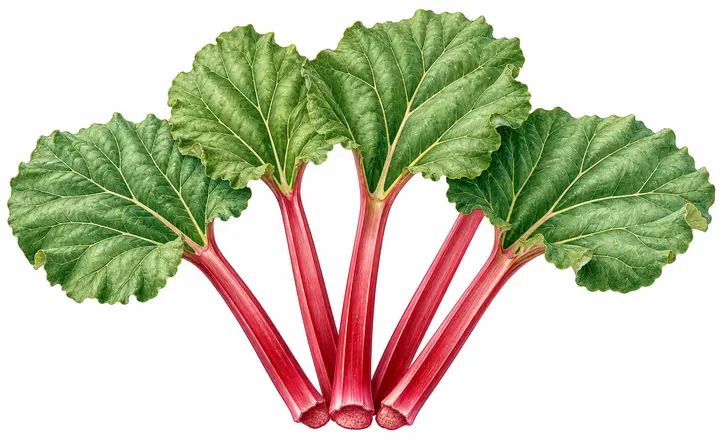
Quick answer
Plant a healthy named rhubarb crown in full sun or light shade with fertile moisture-retentive soil that never remains waterlogged. Keep the growing point at or just above the surface, allow roughly 75–90cm between plants and leave the first season completely unharvested.
Take only a few stalks in the second year. Once established, pull selected stalks from the base while leaving most foliage to feed the crown, and stop the main harvest by early to midsummer. Eat only the leaf stalks: rhubarb leaves are not edible.
Choose crowns rather than relying on seed
Named cultivars differ in vigour, stalk colour, harvest season and suitability for forcing. Redder stalks are not necessarily sweeter. Division-grown crowns reproduce the named plant, while seed produces variable offspring and adds time before harvest.
Buy a healthy dormant crown or potted plant from a reputable supplier. A division from another garden should come only from a vigorous plant without persistent crown rot or virus-like distortion.
The RHS rhubarb guide describes a large hardy perennial that needs patience in its first two seasons and can remain productive for many years.
Site and soil
Choose an open site with sun or light shade and room for leaves that can spread close to a metre or more. Avoid frost pockets, because emerging growth can be damaged, and avoid low ground that holds winter water.
Rhubarb favours fertile soil that retains moisture but drains freely, with a tested pH around 5.5–6.5. Remove perennial weeds before planting. Add mature organic matter where soil condition justifies it, but do not create a water-holding pocket in heavy ground.
Plant crowns and divisions
Plant dormant crowns from late autumn to early spring while soil is workable, or potted plants in mild weather with reliable water. Set the growing point at or just above soil level; slightly raised planting can help on heavier soil. Burying the crown encourages rot.
Space plants roughly 75–90cm apart or more for vigorous cultivars. Water after planting, label the variety and remove flower stalks if they appear during establishment. Do not pull any edible stalks in year one.
Divide congested or declining healthy crowns during dormancy. Each division needs a sound piece of crown and at least one strong bud. Discard soft, hollow or diseased sections rather than spreading them.
Containers and small gardens
Rhubarb is large and long-lived, so ground culture is more forgiving. For a compact cultivar, use a very large stable container around 50cm wide with at least 40 litres of growing medium, free drainage and space for the leaf canopy.
Container crowns dry and exhaust their medium faster. Water deeply, renew the surface and feed from product guidance. Protect the pot from prolonged saturation and severe root-zone temperature swings.
Water, mulch and flowers
Water new plants and established crowns during prolonged dry periods, especially in spring. Apply mature organic mulch around—not over—the crown. Soil-test results and growth should guide fertiliser; excessive feeding cannot correct poor drainage.
Remove flower stalks near their base as soon as practical so the crown does not divert unnecessary energy into seed. Allow normal leaves to remain until they die back naturally in autumn, then clear collapsed material from the crown.
Forcing rhubarb
Forcing excludes light from a mature dormant crown to produce earlier pale tender stalks. Cover one strong established crown in winter with a purpose-made pot or stable light-excluding container that allows access and does not damage shoots.
Harvest the forced crop as directed, then uncover the crown and leave it unharvested for the rest of that season so foliage can rebuild reserves. Do not force the same crown every year.
Protecting and diagnosing rhubarb
| Symptom | Likely causes to investigate | First checks |
|---|---|---|
| Crown becomes soft and collapses | Waterlogging, crown rot or deep planting | Drainage, planting depth and tissue condition |
| Stalks split | Irregular moisture or rapid weather change | Recent rain, drought and irrigation |
| Leaves small and stalks thin | Young crown, overharvest, drought or congestion | Plant age, harvest record and moisture |
| Flower stalk develops | Normal maturity or plant stress | Plant age and crown condition |
| Young leaves have holes | Slugs, snails or physical damage | Slime, shelter and damage timing |
| New growth distorted or mottled | Virus, herbicide injury or other stress | Pattern, nearby treatments and plant history |
Do not eat the leaves. Discard badly frost-damaged or decaying stalks and use current local food guidance when severe freeze injury creates uncertainty.
Harvest and handling
Grip a stalk low, pull outward and twist so it releases cleanly from the crown. Do not cut every stalk across the base or remove more than a minority of the plant at one time. Stop the main harvest by early to midsummer and leave the remaining foliage intact.
Remove and discard the leaf blade from food preparation. Refrigerate clean stalks for short storage or freeze and preserve them using a tested process. Record planting year, cultivar, harvest start and stop, forcing and division so the crown is not accidentally overworked.
Sources and review basis
- How to grow rhubarb — Royal Horticultural Society
- Growing rhubarb in home gardens — University of Minnesota Extension
Plant size, forcing response and harvest window vary by cultivar and climate. Never eat rhubarb leaves.