Quick answer
Rocket is a quick salad crop for cool weather, moist but freely drained soil and sun or light shade. Sow a short row or a small container every two to three weeks rather than making one large sowing. Thin plants to about 10cm for repeated leaf picking, water during dry spells and harvest when leaves are young and tender.
Spring and autumn usually give the mildest leaves. Heat, drought and crowding make plants bolt sooner and taste stronger. Fine insect mesh fitted immediately after sowing is the most reliable defence where flea beetles pepper the leaves with small holes.
Choose a type and a growing window
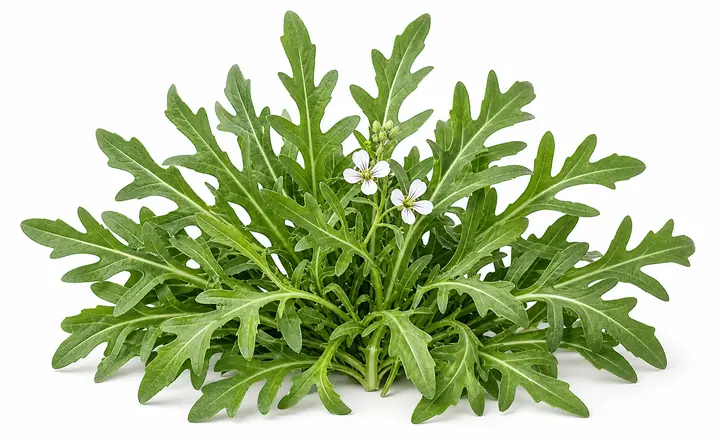
Salad rocket, Eruca vesicaria subsp. sativa, is a fast annual with relatively broad lobed leaves and creamy flowers. Seed packets labelled wild rocket usually contain Diplotaxis tenuifolia, a slower perennial with narrower leaves and a stronger flavour. This guide covers salad rocket, although the general approach is similar.
Choose a bolt-resistant cultivar for late-spring sowings and a cold-tolerant one for autumn or protected winter crops. Rocket can produce usable leaves in roughly a month, so it works well between slower crops and in containers. Do not rely on one sowing to crop all season: mature plants naturally flower, and replacement rows give better-quality leaves.
Site, light and soil
Use an open position with four hours or more of direct light. Full sun suits cool months; light afternoon shade can slow stress in warm weather. Avoid a deeply shaded, stagnant corner, where leaves stay wet and growth becomes soft.
Rocket prefers fertile, moisture-retentive soil that drains freely, around pH 6.0–7.0. A pH figure is a planning range, not a reason to amend soil without a test. Rake the surface to a fine texture, remove weeds and break up crusted soil so small seedlings emerge evenly. Where recent compost has improved the preceding crop, extra feeding is rarely needed.
Sow outdoors or under cover
Sow outdoors from early spring, once soil is workable, until early autumn. Make a shallow drill about 1cm deep, water it if dry, scatter seed thinly and cover lightly. Leave about 20–30cm between rows. Thin seedlings progressively, eating the thinnings, until plants intended for repeated picking stand about 10cm apart. Give plants nearer 15–20cm if you want large individual rosettes.
For an earlier or more controlled start, sow a few seeds per module and transplant the small plugs promptly before they become root-bound. Harden indoor-raised plants before moving them outside. In late autumn, sow in a greenhouse border or an unheated cold frame; growth becomes slow in short days, so establish plants before light levels fall.
Repeat a modest sowing every two to three weeks. Pause during very hot, dry weather if irrigation and shade are unavailable, then restart as conditions cool.
Grow rocket in containers
A trough, window box or pot at least 20cm across and 15–20cm deep is sufficient for a small group. Use peat-free multipurpose growing medium and ensure drainage holes remain open. Sow across the surface or in short rows, then thin so air can move among mature leaves.
Containers dry faster than beds, which can make rocket unexpectedly hot and trigger flowering. Check moisture below the surface every day in warm or windy weather. Water thoroughly, let excess drain and avoid leaving the pot standing permanently in water.
Water, weed and protect the crop
Keep the root zone evenly moist without saturating it. Water at soil level in the morning where possible so foliage dries quickly. A thin organic mulch around established plants can reduce evaporation, but keep coarse material away from tiny seedlings.
Hoe shallowly or hand weed to avoid disturbing rocket's roots. If leaves are pale and growth remains weak despite adequate light, moisture and root room, use a soil test or the container-feed label before adding nutrients. Heavy nitrogen feeding encourages soft growth and does not correct heat, crowding or damaged roots.
Flea beetles make many small round holes, especially in young leaves. Cover the seedbed immediately with fine insect mesh, seal the edges and leave enough slack for growth. Covers work only if beetles are not trapped underneath. Slugs and snails may remove seedlings, while pigeons can graze uncovered rows.
Delay bolting and manage flowers
A lengthening central stem followed by flower buds marks bolting. Warmth, long days, drought and root restriction accelerate it. Prompt watering, adequate spacing, afternoon shade and succession sowing help, but no treatment turns a flowering annual back into a young rosette.
Pick an entire bolting plant if tender leaves are the priority. Alternatively, let a few healthy plants flower: the four-petalled flowers are edible and useful to pollinators. Remove plants before seed matures if self-sowing would be a nuisance or if nearby brassicas need a clean rotation.
Diagnose common problems
| Symptom | Likely causes to investigate | First checks |
|---|---|---|
| Many tiny round holes | Flea beetles | Young leaves, jumping beetles and mesh gaps |
| Seedlings disappear | Slugs, snails, birds or a dry seedbed | Night-time pests, tracks, cover and soil moisture |
| Leaves become very hot or tough | Plant age, drought, heat or bolting | Growing point, moisture and recent weather |
| Leaves yellow from below | Waterlogging, exhausted compost, crowding or normal ageing | Drainage, roots, spacing and oldest leaves |
| Dark or water-soaked leaf spots | Bacterial or fungal leaf disease | Prolonged leaf wetness, airflow and affected debris |
| Plants flower while small | Heat, long days, drought or root restriction | Sowing date, temperature, watering and pot size |
Remove badly affected plants and crop debris rather than composting material with an uncertain disease. Rotate rocket with other brassicas and identify the cause before using any product on an edible leaf crop.
Harvest and store
Begin cutting individual outer leaves when they are large enough to use, leaving the central growing point intact. Alternatively, shear a patch a few centimetres above the soil and allow one or two regrowths. Regular small pickings produce better leaves than letting the row become over-mature.
Harvest in the cool of the morning, rinse only when needed and dry leaves well. Refrigerate promptly in a breathable or loosely closed container and use soon; rocket loses texture and aroma quickly. Flowers can be added to salads, but do not eat plants treated with a product whose label excludes that use.
Sources and review basis
- How to grow rocket — Royal Horticultural Society
- Production limitations of arugula in the Northeast — Penn State Extension
- Vegetables in containers — Royal Horticultural Society
UK sowing and harvest timing follows the RHS. Seed-packet instructions, local frost conditions, soil-test results and current edible-crop product labels take precedence over general ranges.