Quick answer
Salsify is a hardy biennial normally grown for its long pale roots in one season. Sow directly outdoors in spring, about 1–2cm deep, in a sunny bed of deep, fine, stone-free soil. Thin seedlings to 10–15cm, keep the slow-growing row weed-free and water during prolonged dry periods.
Lift roots from mid-autumn through early spring, loosening the soil deeply with a fork before pulling because snapped roots bleed sticky white sap. Frost improves the flavour, and undisturbed roots keep better in the ground than after lifting. Mark the row and protect it with a loose mulch if frozen soil would prevent harvesting.
Identify salsify and choose seed
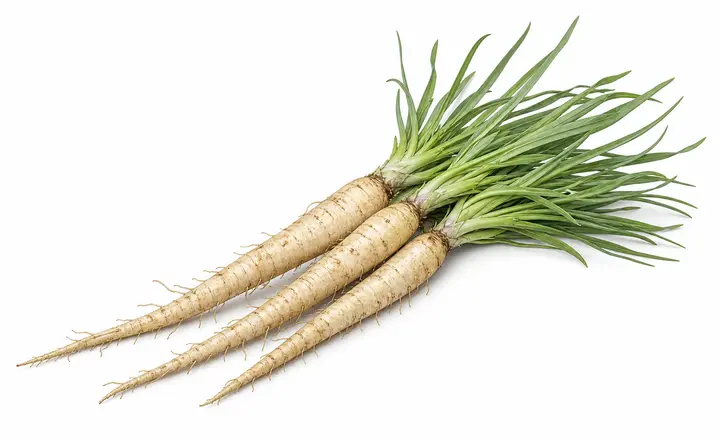
True salsify is Tragopogon porrifolius, a member of the daisy family with narrow leaves, creamy-white roots and purple-pink flowers in its second year. It is not scorzonera or black salsify, Pseudopodospermum hispanicum, which has dark skin and different flowers. Cultivation is similar, but seed packets and kitchen instructions should match the crop you have.
Only a few salsify selections are widely available. Choose fresh seed from a reliable supplier; germination can fall with age. Long-rooted cultivars need especially deep, fine soil, while a deep container can be useful where native ground is stony or compacted.
Site, light and soil
Choose full sun and soil that drains freely but does not dry abruptly. The ideal bed is cultivated deeply enough for roots approaching 30cm, with stones, hard clods and perennial weed roots removed. Compaction causes stunting; obstructions and fresh lumps of manure encourage branching.
Aim for a slightly acidic to neutral soil, approximately pH 6.0–7.0, and test before amending it. The RHS salsify guide recommends a bed where organic matter was added for the preceding crop rather than one freshly manured immediately before sowing. On a no-dig bed, sow into a deep, mature and even surface layer that roots can penetrate.
Direct sow and thin seedlings
Sow where the crop will mature, as transplanting can distort the taproot. From early to mid-spring, make drills 1–2cm deep and about 30cm apart. Sow thinly, cover with fine soil and water with a gentle rose. Keep the seedbed consistently moist until emergence, which may be slow and uneven in cold conditions.
Thin in stages once seedlings can be handled, ultimately leaving 10–15cm between plants. Snip unwanted seedlings at soil level if pulling them would disturb neighbours. Clearly label the row: narrow young leaves are easily mistaken for grass, and slow early growth lets weeds overtake them.
Grow salsify in a container
Use a deep container—at least 30cm across and preferably 40cm or more deep—with unobstructed holes. A 20-litre pot can support about three plants, while a larger container permits wider spacing and straighter roots. Fill it with a fine, stable, peat-free growing medium without stones or partly decomposed chunks.
Direct sow, then thin to the strongest evenly spaced plants. Do not allow the medium to alternate between bone dry and saturated. Container roots may be shorter than those in a well-prepared bed but are often easier to lift intact.
Water, mulch and weed
Water seedlings whenever the surface begins to dry. Once established, ground-grown salsify usually needs extra water only during long dry spells, but reliable moisture reduces the risk of fibrous or split roots. Water deeply rather than repeatedly wetting only the surface.
Apply a light mature-organic mulch in late spring after plants are established, keeping it away from the crowns. This conserves moisture and suppresses later weeds. Feeding is normally unnecessary in prepared ground; excessive nitrogen can favour leaves over useful roots. Use a soil test or container-feed label if growth is genuinely deficient.
Hand weed close to plants and hoe very shallowly between rows. Damaging the crown or upper taproot creates entry points for decay and can cause branching.
Prevent poor roots and bolting
Forked roots usually trace back to stones, compacted layers, root disturbance or recently applied coarse manure. Splitting is associated with uneven moisture, especially heavy rain or watering after drought. Neither problem can be repaired late in the season, so preparation and steady growth matter more than corrective feeding.
Salsify is naturally biennial and flowers after winter, but stress can cause premature bolting. Keep spring sowings growing steadily and remove an early flower stalk if the root is still worth harvesting. Plants deliberately left for seed can produce attractive edible buds and petals, but allow only healthy, correctly identified plants to self-sow.
Diagnose common problems
| Symptom | Likely causes to investigate | First checks |
|---|---|---|
| Roots fork into several prongs | Stones, compaction, fresh manure or early root damage | Bed preparation and soil profile |
| Roots split | Drought followed by heavy rain or watering | Recent moisture pattern and drainage |
| Seedlings fail in gaps | Old seed, dry crusted soil, slugs or birds | Seed age, seedbed moisture and pests |
| Leaves pale and growth stalls | Waterlogging, severe competition or low fertility | Drainage, weeds, spacing and soil test |
| Plant flowers in the first season | Stress, drought or unusual temperature pattern | Moisture, sowing date and central stalk |
| Roots snap during harvest | Dry or compacted soil and pulling without loosening | Fork depth and soil condition |
Salsify has few serious problems, but slugs and snails may graze seedlings. Identify damage before choosing a control and use only products currently labelled for the edible crop.
Harvest, store and use
Begin lifting from mid-autumn once roots are useful in size. Insert a fork well to the side and full depth, loosen the whole section, then ease roots upward without pulling against firm soil. White sap from a cut root is normal but discolours; place prepared roots in acidulated water if a recipe recommends it.
Leave the rest in the ground and lift as needed through winter. A layer of straw or dry leaves can keep the surface workable in frost. If drainage is poor or rodents are active, lift sound roots and refrigerate them cool and humid for short-term storage rather than leaving them exposed to damage.
Roots left until spring can be harvested before flowering growth develops. Young shoots and unopened flower buds are also edible, but use a reliable preparation guide and never eat a plant unless its identity is certain.
Sources and review basis
- How to grow salsify — Royal Horticultural Society
- Quick guide to fertilising plants — University of Minnesota Extension
UK sowing and harvest timing follows the RHS. Seed-packet directions, soil-test results, local conditions and current edible-crop product labels take precedence over general ranges.