Quick answer
Grow watermelons in the warmest, sunniest position available, with fertile, freely draining soil and a long frost-free season. In most of the UK, a greenhouse or polytunnel gives the best chance of ripe fruit. Choose a short-season, small-fruited cultivar, sow with heat in mid-spring and plant only when the root zone is warm and night temperatures stay reliably above 12–15°C.
Keep moisture steady while vines and fruits are expanding, but never leave roots saturated. Allow ample trailing space or train only a compact, small-fruited cultivar on a strong support, with every hanging fruit in its own sling. Watermelons do not become sweeter after picking, so use several ripeness signs together: a yellow ground spot, a dry tendril nearest the fruit and a rind that has lost some shine.
Choose a variety for the season and space
Watermelon, Citrullus lanatus, is a different species from sweet melon, Cucumis melo. Its vines are vigorous and standard cultivars can overwhelm a small bed. The RHS melon guide recommends protected culture and a compact or cool-climate cultivar for the best chance of success in the UK.
Compare days to maturity, mature fruit weight, vine spread and disease resistance before buying seed. Treat catalogue maturity figures as comparisons between cultivars, not a harvest promise: cool, cloudy conditions extend the season. A small “icebox” type is more realistic for a container, trellis or short summer than a large-fruited field variety.
Seedless watermelons need more planning. They are normally triploid plants and still require pollen from a compatible seeded diploid cultivar. Buy a matched seed-and-pollinizer combination and follow its layout instructions; a seedless plant grown alone may flower but fail to set usable fruit. The University of Minnesota Extension melon guide explains this pollination requirement.
Heat, light and soil
Give plants at least six hours of direct sun, with eight or more preferable. A greenhouse should be warm but ventilated: excessive heat and closed doors during flowering can reduce pollinator access and fruit set.
Watermelons grow best in fertile, well-drained sandy loam. A soil pH of 6.0–6.5 is a sound target, supported by the University of Minnesota guidance. Test garden soil before trying to correct its pH, and use the laboratory recommendation rather than adding lime by habit.
Incorporate mature compost where the soil needs more organic matter. Raised beds improve drainage and warm more quickly, but they also dry faster. Dark mulch can warm cool soil; organic mulch conserves moisture once the soil is already warm, but applying it too early can delay warming.
Sowing and transplanting
Sow indoors about three to four weeks before the expected planting date. Use one seed per small pot or module, about 1–2.5cm deep, and provide bottom heat. Germination is most reliable in a warm medium; Minnesota Extension gives 21–32°C as the useful germination range and advises waiting for soil to reach at least 18°C before planting.
Move seedlings into strong light as soon as they emerge. Avoid starting too early: a compact plant with two or three true leaves is easier to establish than a tangled vine. Water the pot before transplanting, keep the root ball intact and plant at the same depth. Cucurbit roots resent disturbance.
Harden plants gradually without chilling them. Plant into a protected bed or container from late May only when the structure remains reliably warm. Outdoor planting is usually later and should wait until frost risk has passed, nights remain above 12–15°C and the soil is at least 18°C. Direct sowing is practical only where those conditions arrive early enough to leave a full ripening season.
Containers, ground spacing and support
For a compact, small-fruited cultivar, use one plant in a container at least 40cm wide and deep, with roughly 40 litres or more of fresh peat-free potting compost. A larger volume gives better temperature and moisture stability. Keep drainage holes clear and put the container in its final sunny position before vines spread.
In open ground, space typical plants 90–120cm apart and allow about 180–210cm between rows or an equivalent area for vines. Compact cultivars may need less and exceptionally vigorous cultivars more, so the seed supplier's spacing takes precedence. Guide vines into clear paths rather than repeatedly lifting and twisting them.
Let standard watermelons trail. Trellising is suitable only for manageable, small-fruited cultivars on a structure designed for the mature load. As each fruit enlarges, cradle it in a broad, quick-drying sling attached to the support, never to the vine. Put ground-level fruit on a tile, board or dry straw to reduce contact with damp soil.
Watering, feeding and vine management
Water deeply at the root zone, then check the soil rather than following a fixed calendar. Keep moisture consistent during establishment, flowering and fruit expansion. Repeated drought-and-saturation cycles can check growth or split fruit, while permanent wetness encourages root problems. Reduce irrigation gradually as fruit approaches maturity, but do not let the whole plant collapse from drought.
Base feeding on a soil test in the ground. In containers, use a balanced liquid feed at the labelled dilution while plants establish, then a feed suitable for fruiting crops after fruit set. Excess nitrogen can produce abundant vine growth without improving ripening, and extra feed cannot correct cold or waterlogged compost.
Routine hard pruning is unnecessary for trailing plants. Remove badly damaged leaves and direct vigorous shoots where they have room. In a short season, thinning late or weak fruits can concentrate the plant's resources on those already developing, but there is no universal fruit count: cultivar size, plant vigour and remaining warmth all matter.
Flowers, pollination and fruit development
Watermelon vines usually carry separate male and female flowers on the same plant. Female flowers have a small swollen ovary behind the petals. Bees must move pollen to them; cold, wet weather or a closed greenhouse can leave tiny fruits yellowing and dropping.
Open greenhouse vents and doors during flowering where safe, and remove insect-excluding covers once flowers open. Avoid spraying flowers or using any pesticide that could harm visiting pollinators. If insects are scarce, transfer fresh pollen from a male flower to the centre of a newly open female flower in the morning.
Poor pollination can produce misshapen fruit as well as complete failure. A seedless cultivar still needs its specified pollinizer nearby. Once fruit is swelling, keep a healthy leaf canopy: aggressive leaf removal reduces the plant's ability to produce the sugars that determine eating quality.
Diagnosing common problems
| Symptom | Likely causes to investigate | First checks |
|---|---|---|
| Seed fails or rots | Compost too cold or saturated | Medium temperature, drainage and seed condition |
| Plant stalls after transplanting | Root disturbance, cold soil or cold nights | Root-ball damage and measured temperatures |
| Flowers form but no fruit develops | Poor pollination, heat stress or no pollinizer for a seedless cultivar | Flower type, insect access and cultivar instructions |
| Tiny fruit yellows and drops | Incomplete pollination or plant stress | Recent weather, watering and pollen transfer |
| Fruit is misshapen | Incomplete pollination or uneven moisture | Seed set, pollinator activity and watering history |
| Fruit splits | Sudden water uptake late in development | Recent rain or irrigation after dry soil |
| White coating spreads over leaves | Powdery mildew | Whether the coating rubs off and how it is spreading |
| Leaves are mottled, curled or stunted | Virus or sap-feeding pests | New growth, leaf undersides and pattern across the plant |
| One runner wilts while soil is moist | Stem injury or a wilt/root disease | Stem base, roots, drainage and whether symptoms advance |
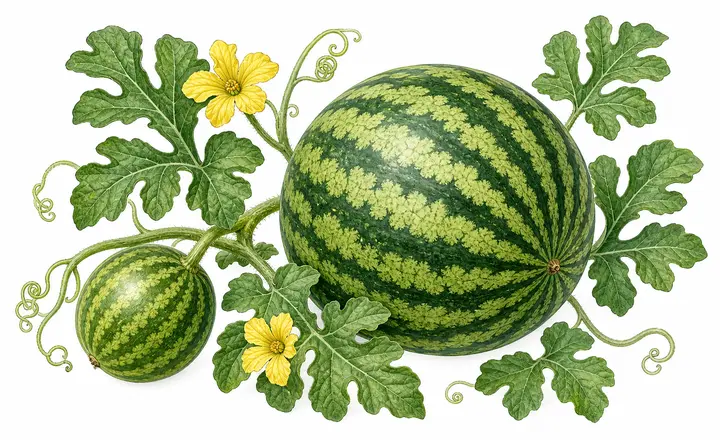
Natural watermelon leaves are deeply lobed and can vary in colour, but mosaic-like distortion and stunting are not normal. Identify the cause before treating. Remove severely diseased material, clean supports and use an appropriate crop rotation where a soil-borne disease has been confirmed; do not reach for a pesticide without a diagnosis and a product specifically authorised for the crop and setting.
Harvest, storage and end of season
Judge ripeness with a combination of signs. The patch resting on the ground usually changes from pale or white-green to creamy yellow, the tendril closest to the fruit dries brown and the rind becomes duller. A ripe fruit may sound hollow when tapped, but sound alone is unreliable and varies by cultivar.
Watermelons do not “slip” from the stem and do not gain sweetness after harvest. Cut the stalk cleanly, leaving a short handle, once several signs agree. University of Minnesota Extension's harvest guidance confirms that watermelon is non-climacteric and should remain on the vine until ripe.
Handle the rind carefully and use the fruit promptly. Store whole watermelons in a cool place away from ethylene-producing fruit such as apples and bananas. Refrigerate cut watermelon in a clean covered container. At the end of the season, remove vines after frost, declining light or disease ends growth; compost only healthy material, clean reusable slings and supports, and record the cultivar, planting date, first fruit set and harvest result.
Sources and review basis
- How to grow melons — Royal Horticultural Society
- Growing melons in the home garden — University of Minnesota Extension
- Growing melons in a home garden — University of Maryland Extension
- How to grow watermelon in your garden — Utah State University Extension
- Harvesting and storing melons, squash and pumpkins — University of Minnesota Extension
Dates, fruit counts and maturity figures vary with cultivar and climate. Use measured soil and night temperatures, follow seed-supplier instructions for seedless pollinizers, and adjust feeding from soil tests and product labels.