Quick answer
Grow zucchini—called courgettes in the UK—in a warm, sunny position with fertile, moisture-retentive soil and enough room for a broad canopy. Sow after the soil warms or transplant a young plant without disturbing its roots. Water deeply at the base, keep flowers accessible to pollinators and harvest small tender fruit several times a week.
One or two healthy plants can supply a household. Planting many close together increases competition and humidity without guaranteeing more fruit. A standard plant needs roughly a metre of space or one large container to itself.
Choose the growth habit
Most modern zucchini are described as bush types, but their large leaves still spread widely. Trailing summer squash needs more ground or can be trained carefully. Compact cultivars are the best candidates for containers, while spine-free stems make frequent harvest easier.
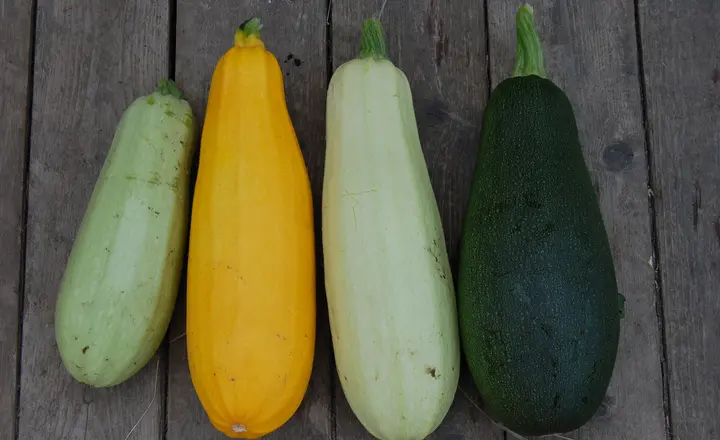
Fruit may be long, round, green, yellow or striped. The RHS courgette guide recommends disease-resistant cultivars where damp, humid summers make mildew common.
Zucchini is a summer squash harvested immature. If fruit is left to become marrow-sized, the skin hardens, seeds enlarge and the plant slows production.
Site, soil and temperature
Choose a sheltered location receiving at least six hours of direct sun. Frost kills the plants and cold soil delays or rots seed. The University of Minnesota Extension recommends direct sowing only after soil at 5cm depth reaches about 21°C.
Use fertile soil that holds water but drains freely, with a working pH target around 6.0–6.5. Incorporate mature compost into the planting area. Raised beds help drainage but can dry faster in summer.
Prepare a broad watering basin around the root zone without burying the crown. Mulch after the soil warms to reduce evaporation and prevent soil splashing onto leaves.
Sowing and transplanting
For an early crop, sow one seed per small pot under protection in mid- to late spring. Provide warmth for germination and bright light immediately after emergence. Seedlings grow quickly, so start only a few weeks before safe planting conditions.
Harden plants gradually. Transplant the intact root ball at the same depth after frost risk has passed and nights are reliably mild. Protect the first week from wind and slugs.
Direct sowing avoids transplant shock. Sow two seeds per station and retain the strongest seedling. Do not repeatedly pull apart intertwined roots; cut the weaker seedling at soil level if necessary.
Spacing and containers
Allow 90–100cm between standard plants, more for trailing cultivars. The mature leaf spread matters more than the size at planting. Adequate spacing keeps flowers visible, allows access for harvest and improves airflow.
Use one compact plant in a container of at least 40 litres and 45cm diameter. Larger is easier to water. Fill with fresh peat-free potting compost, keep drainage open and stabilise the vessel against the weight of a lopsided canopy.
A growing bag may hold one or two compact plants only if it provides comparable root volume. Small decorative pots dry too quickly for sustained fruiting.
Watering and feeding
Water deeply whenever the root zone begins to dry, especially once fruits form. Apply water to soil rather than pouring it into the crown or over leaves. Shallow sprinkling encourages surface roots and leaves deeper soil dry.
Containers may need daily checks in warm weather. Wilting at midday can occur even in moist soil, but plants that remain wilted into the evening need investigation. Check moisture before adding more water; wilt also results from root rot or stem-boring insects.
Feed container plants at the labelled rate once flowering and fruiting are established. In garden soil, use a soil test or a modest balanced application. Excess nitrogen creates a huge canopy that is difficult to manage and may delay fruiting.
Flowers and pollination
Separate male and female flowers grow on the same plant. Male flowers have a slender stem; female flowers carry a miniature fruit behind the petals. Early plants often produce male flowers first, which is normal.
Bees transfer pollen. Cold, rain and low insect activity can cause young fruit to yellow and rot from the blossom end. Hand-pollinate by moving fresh pollen from a newly opened male flower onto the central stigma of a female flower. Do this in the morning while flowers are open.
Do not remove all male flowers for eating if fruit production is the goal. Keep pesticide use away from open flowers and follow pollinator precautions on any food-crop label.
Diagnosing common problems
| Symptom | Likely causes to investigate | First checks |
|---|---|---|
| Tiny fruit yellows and drops | Incomplete pollination, cold or root stress | Flower timing, bee activity and moisture |
| White powder spreads on leaves | Powdery mildew | Whether coating rubs off and how it progresses |
| Whole plant wilts despite moist soil | Crown rot, root damage or squash vine borer | Crown, stem entry holes and drainage |
| Leaves show silver patches | Normal cultivar markings or pest damage | Symmetry, texture and progression |
| Few female flowers | Young plant, excess nitrogen, shade or heat | Plant age, feeding, light and weather |
| Fruit skin becomes tough | Fruit left too long | Harvest frequency and cultivar size |
Many zucchini leaves have stable silver marbling that is not mildew. Powdery mildew forms an expanding surface coating. Photograph changes over several days before removing functional leaves.
Harvest and kitchen safety
Cut fruit when it is about 15–20cm long for standard cylindrical types, or at the cultivar's recommended immature size. Check beneath leaves every two or three days. Hold the fruit and cut its short stem cleanly rather than twisting the crown.
Use scratched fruit first and refrigerate only briefly; zucchini is sensitive to prolonged cold storage. Freeze or preserve surplus with a tested method.
Discard and do not taste zucchini that is intensely bitter. Rarely, cucurbit plants can contain high concentrations of bitter cucurbitacins, especially from unsuitable saved seed or ornamental crosses. Cooking does not reliably remove them.
At season's end, record plant count, first harvest and whether mildew or pollination limited production. That evidence helps determine whether the next crop needs a different cultivar, spacing or sowing date.
Sources and review basis
- How to grow courgettes — Royal Horticultural Society
- Growing summer squash and zucchini — University of Minnesota Extension
Cultivar size and local soil temperature determine planting. Treat spacing and container volume as practical minimums, not guarantees.