Quick answer
Choose a named blackberry cultivar whose mature spread, cane habit and winter hardiness fit the site. Plant it in sun or light shade in fertile, moisture-retentive but freely draining soil, put a sturdy wire support in place before planting and keep the roots evenly moist while the plant establishes and the berries swell.
Most garden blackberries fruit on second-year canes. After harvest, cut those fruited canes to the base and train in the healthy new canes that will carry next year's crop. Primocane-fruiting cultivars can also crop on current-season growth and need cultivar-specific pruning, so confirm the fruiting type before making any cuts.
Choose the cultivar and cane habit first
Blackberry cultivars may be trailing, semi-erect or erect, and thorned or thornless. A vigorous trailing plant can occupy several metres of wire, while a genuinely compact cultivar can fit a large container. Thornlessness makes training and picking easier but does not indicate mature size, flavour, season or cold tolerance.
Most traditional cultivars give one crop on floricanes—the canes that grew during the previous season. Primocane-fruiting or “everbearing” cultivars can fruit on new canes later in the season and may also carry an earlier floricane crop if those canes are retained. Select for the regional climate and intended pruning system rather than assuming every blackberry behaves alike.
One cultivar can set fruit without a second polliniser, according to Oregon State University Extension. More than one can extend the harvest, but it is not required for cross-pollination. Buy certified disease-free stock from a reputable nursery instead of transplanting a wild bramble or an unexplained sucker.
Conditions that determine success
Full sun gives the best yield, flavour and ripening, although blackberries can fruit in light shade. Choose a sheltered position with enough airflow for leaves and fruit to dry. Avoid a frost pocket, exposed wind and ground that stays waterlogged through winter.
The soil should be fertile, deep enough for a long-lived perennial root system and able to retain useful moisture without excluding air. Remove perennial weeds before planting because they become difficult to separate from arching or thorny canes.
A tested pH of 5.6–6.5 is a useful target from the Oregon State blackberry guide. Do not add lime or sulfur from a blanket recipe: test first, use a recommendation calibrated to the measured pH and soil type, and allow time for any amendment to work.
Plant or propagate
Mid-autumn to early spring is the usual planting window for dormant bare-root plants in the UK, provided the soil is workable rather than frozen or waterlogged. A container-grown blackberry can be planted more widely through the year when the soil is suitable and reliable watering is available, but avoid hot, dry weather.
Install posts and wires first. For a pot-grown plant, set the top of the root ball level with the surrounding soil. For bare-root stock, spread the roots without sharply bending them and place the uppermost roots about 5cm below the surface, following the nursery instructions. Firm gently and water thoroughly.
Allow 2.5–3.5m between moderately vigorous plants; particularly vigorous cultivars may need up to 4m. Compact or erect types may use different spacing, so the named cultivar's mature width takes priority. Keep access space in front of the wires for pruning and harvest rather than measuring between crowns alone.
Blackberries can be cloned by pinning a vigorous shoot tip into soil in mid- to late spring, then separating the rooted layer after it has established. Seedlings will vary and will not preserve a named cultivar. Propagate only a healthy, unrestricted plant; some cultivars are protected, and moving suckers can spread viruses, pests and contaminated soil.
Containers and restricted spaces
Choose a cultivar explicitly described as compact and container-suitable. Use one plant in a stable container at least 45cm wide and deep; about 75 litres is a practical minimum for the deep root system. Vigorous semi-erect plants are poor container subjects even if aggressive pruning could temporarily make them fit.
Use a durable peat-free, loam-based growing medium and keep drainage holes unobstructed. Give any non-self-supporting cultivar its own anchored wires or trellis rather than relying on the pot rim. Check roots, drainage, cane balance and stability each year, moving up in size before the plant becomes severely congested.
Water, mulch and feed
Water thoroughly after planting and check new plants through their first growing season. Established blackberries tolerate short dry periods, but drought while flowers and fruit are developing can reduce berry size and quality. Check moisture below the surface and water the root zone deeply enough to wet it without leaving standing water.
Container plants need frequent checks throughout active growth. Water until surplus drains, then check again before the medium dries completely. Avoid routine overhead irrigation late in the day because persistently wet flowers, foliage and fruit favour disease.
Apply clean mature organic mulch in early spring to conserve moisture and suppress weeds, leaving the crown and cane bases visible. Regularly mulched, fertile ground may need no extra feed. If growth or cropping is poor, inspect light, water, pruning, roots and a soil test before using fertiliser. Follow the product label; excess nitrogen encourages soft, tangled growth and cannot correct shade or root damage.
Flowering, fruit development and crop protection
Most cultivars flower on short laterals from second-year canes. Their nectar-rich flowers attract pollinating insects, but cool wet conditions or frost during bloom can reduce fruit set. Protect open flowers with supported horticultural fleece if a damaging frost is forecast, removing it during the day.
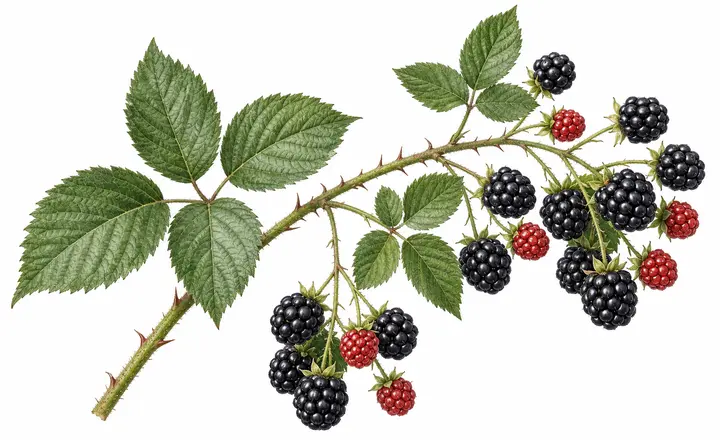
Keep moisture steady as berries enlarge and change from green through red to black. Fruit exposed to intense heat may develop pale or scorched drupelets, while hard red drupelets that fail to darken can indicate red berry mite. Diagnose the texture and exposure pattern rather than assuming every uneven berry has the same cause.
Birds and mammals may take ripening fruit. Use a well-built fruit cage or taut, securely fastened netting held away from the berries, inspect it frequently for trapped wildlife and remove temporary protection after harvest.
Support and prune the correct canes
Train vigorous plants along horizontal wires on stout posts, a fence or a wall. Several wires spaced about 45cm vertically provide a practical framework. Use soft ties and keep new green primocanes separate from the older fruiting canes; that separation prevents the next crop from being removed accidentally.
For an established floricane-fruiting blackberry, cut each old fruited cane to ground level after the crop finishes. Old canes are browner and carry spent fruiting laterals. Retain healthy new canes, remove weak or damaged ones and fan or bundle the selected replacements onto the support without kinking them.
Do not apply that system unchanged to a primocane-fruiting cultivar. A single late crop can be produced by removing all canes during dormancy, while retaining lower portions can allow a second, earlier floricane crop. Follow the named cultivar's regional instructions because the trade-off, winter survival and season length vary.
Wear thorn-resistant gloves, eye protection and long sleeves even around a cultivar sold as thornless, because occasional prickles and cut cane ends can still injure.
Common-problem diagnosis
| Symptom | Likely causes to investigate | First checks |
|---|---|---|
| Berries soften under grey fuzzy growth | Grey mould, overripe fruit or damaged fruit | Wet weather, airflow, canopy crowding and picking frequency |
| Some drupelets stay hard and red on otherwise ripe berries | Red berry mite | Whether red sections are hard, cultivar susceptibility and recurrence across clusters |
| Exposed drupelets turn pale, dry or soft red | Sun and heat injury | Which side faced the sun, recent heat and moisture stress |
| Fruit contains larvae or collapses unusually fast | Raspberry beetle, spotted-wing drosophila or another fruit pest | Open sound fruit, harvest timing and a current local identification guide |
| Leaves curl and feel sticky | Aphids or another sap feeder | Shoot tips, leaf undersides, shed skins and honeydew |
| Canes die back or buds break unevenly | Winter injury, cane disease, root stress or physical damage | Cane interior, lesions, drainage, crown health and recent weather |
| Few flowers or fruit form | Removal of fruiting canes, shade, frost, an immature plant or poor pollination weather | Fruiting type, last pruning cuts, sun and conditions during bloom |
Start with sanitation, correct training, resistant or regionally adapted cultivars, timely harvest and an open canopy. Remove badly affected fruit and dead cane material. Do not spray an unidentified pest or disease; if a plant-protection product is considered, use current local guidance and follow the authorised crop, timing, harvest interval and label exactly.
Harvest, storage and end-of-season care
Blackberries usually ripen in the UK from July into September, depending on cultivar and weather. Pick every few days when the fruit is fully black, plump and comes away with a gentle lift. Many cultivars change from shiny black to a duller black at full ripeness. Blackberries do not continue ripening after picking.
Use shallow clean containers so the berries do not crush one another. Shade and cool the fruit promptly, refrigerate sound dry berries and wash only before use. Freeze berries in a single layer before packing, or use a tested preservation recipe for jams and other stored products.
After the final harvest, remove the correct fruited canes, clear mummified or fallen fruit and inspect wires, posts and ties. Keep weeds out of the crown and record the cultivar, fruiting type, flowering weather, first and last harvest, pruning treatment and any recurring symptoms. Those notes are especially valuable when old and new canes must be managed differently.
Sources and review basis
- How to grow blackberries and hybrid berries — Royal Horticultural Society
- Growing blackberries in your home garden — Oregon State University Extension
- Rubus fruticosus — Kew Plants of the World Online
Cultivated blackberries include diverse Rubus species and hybrids; this reference uses Rubus fruticosus as the practical botanical name, while the nursery label for a named cultivar remains important. Climate, cane habit and fruiting type determine suitable spacing, winter care and pruning.