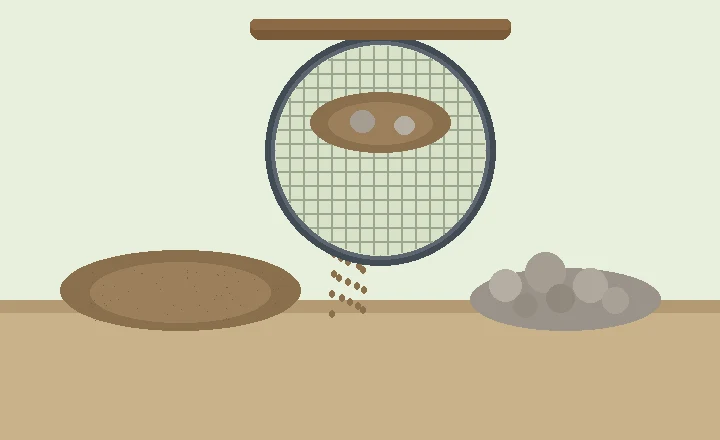
What a garden sieve is for
A sieve sorts material by particle size. You reach for it to remove stones, twigs and large clods from compost or garden soil, to make a fine, even seed compost for trays and modules, and to prepare a smooth, stone-free layer for sowing fine seeds. Because it separates rather than breaks up, it finishes the job a garden rake starts: the rake crumbles clods on the surface, and the sieve removes what is still too coarse to plant into.
Keep the roles separate. A rake levels and crumbles, a hand cultivator loosens the topsoil, and the sieve screens. The Penn State Extension guidance on using the right tool frames the same principle — matching the tool to the job keeps the work efficient and protects your back and wrists across a full session of shaking and rubbing.
Choose the right mesh for the job
Mesh size is the main decision. A coarse screen, around 6 millimetres, is the all-round choice: it clears stones and debris from compost and garden soil while letting the useful crumb through. A finer screen, around 2 to 3 millimetres, can prepare a uniform surface layer for very small seeds, improving seed-to-medium contact and making sowing depth more consistent. Do not sieve all structure out of a potting mix: suitable coarse components help drainage and aeration.
Frame shape matters less than it seems. Round sieves are light and easy to shake with one hand over a tray; rectangular sieves with a handle or legs sit steadily on a bench or trestle for larger batches. Galvanised steel mesh is the durable option and tolerates repeated rubbing; plastic sieves are light and rust-free but the mesh wears and stretches faster. Whichever you choose, the mesh should sit flat and taut in the frame, with no torn or sagging section that would let coarse material through.
Screen dry, crumbly material
Sieve when the material crumbles in a closed fist. Saturated compost smears into the mesh, blocks the openings and recompacts as it dries, so let it dry or turn it first. Set the sieve over a tray, bucket or sheet, feed in a shallow layer, and shake and rub it with a firm, even motion, working the material across the mesh with your palm or the back of a trowel. Lift out stones, roots and debris as they collect on top, and let the fine material fall free.
Work in small batches rather than forcing a heavy load through; a thick layer simply sits on the mesh and slows the job. Sieving dry material raises dust, so work downwind of your face and wear a dust mask for long sessions, particularly with sandy soil or dry peat-free compost.
Make a better potting mix
Screening is the step that makes a home mix behave like a commercial one. A simple all-purpose mix is two parts well-rotted, sieved compost to one part free-draining material such as coarse sand, perlite or grit; the drainage material keeps the mix from compacting in a pot, while the sieved compost supplies structure and some fertility. For seed compost, screen finer and aim for a mix that holds together lightly in a fist but falls apart when poked, so it grips a delicate root without crusting over.
Two cautions. Use only fully rotted, well-composted material, because fresh or half-rotted compost can heat up in a pot and damage young roots. And remember that sieving removes size, not biology: it will not remove weed seed or disease, so do not screen soil from a bed with a known problem and reuse it for seed raising without a reason to trust it.
Care for the mesh and frame
Brush soil from the mesh after each use and dry the sieve before storage, following the RHS hand-tool cleaning guidance, which notes that drying stops metal from rusting and protects any wooden parts. Oil a non-stainless steel frame before a long storage period. Check the mesh for tears and sagging at the end of each season; a small tear can be patched with a scrap of mesh and wire, but a sieve whose mesh has stretched or corroded through should be replaced, because it will no longer sort reliably.
Store the sieve dry under cover, hung or laid flat rather than stacked under heavy tools that can dent the frame and distort the mesh.
Sources and review basis
- Cleaning hand tools: maintenance tips — Royal Horticultural Society
- Using the Right Tool is Self-Care — Penn State Extension
Cleaning, drying, oiling and replacement follow the RHS hand-tool cleaning advice, and tool-to-job matching is informed by Penn State Extension. Mesh sizes, screening technique and potting-mix ratios are working generalisations drawn from common practice, so adjust them to your soil, your seeds and any seed packet or mix instructions, and your own strength and any manufacturer instructions take precedence.