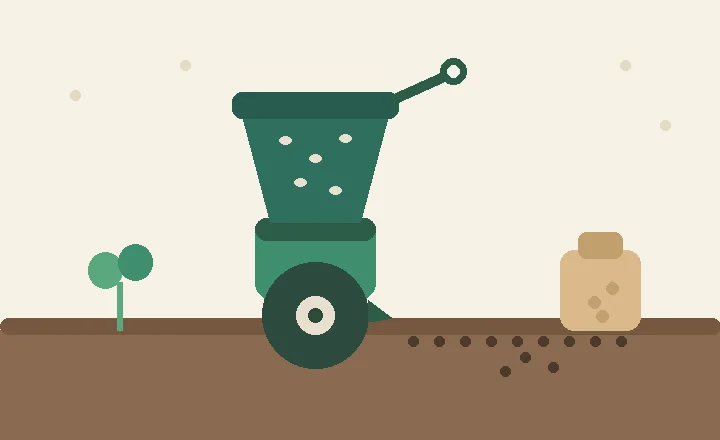
What a seed sower is for
A seed sower solves one problem: small seeds are hard to place by hand. Pinching a pinch of lettuce or coriander seed between your fingers scatters it, so you sow thickly and thin later, or you end up with patchy rows. A sower holds the seed in a hopper and releases it a little at a time as you walk, turning a handful of fine seed into a steady, even line. That saves seed, saves the thinning pass, and gives seedlings room from day one.
It is the right tool for fine and medium seeds sown in rows: lettuce, radish, carrot, coriander, onion, celery, beetroot and small flowers. It is not for large seeds such as beans, sweet corn or courgettes, which are better sown one at a time with a garden dibber, and it is not a substitute for a fine, crumbly seedbed: a sower meters seed, but it cannot sow into clods or stones.
Types of seed sower
Hand-cranked sowers have a hopper above a small wheel and a crank that turns a metering mechanism. Each turn drops a measured amount of seed, so you control the rate by how fast you crank relative to how fast you walk. They are the most versatile type and the best starting point for a vegetable garden.
Push sowers are driven by a wheel that rolls along the row; the seed drops at a rate set by the wheel's rotation, so the pace of your walk sets the spacing. They are simple and fast for even ground, but on soft or uneven soil the wheel can slip and the spacing drifts.
Shaker sowers are a perforated lid over a pocket of seed: you shake it over the bed and the holes let a thin stream through. They are cheap and fine for broadcast sowing of very fine seed, but they give you the least control over spacing, so they suit small areas and flowers more than rows you plan to thin.
Choose the right sower
Match the metering to your seed. Most sowers handle a range, but each has a practical minimum: a mechanism that drops a pea will not meter coriander seed, and a fine mechanism can clog with larger seed. If you mostly sow fine vegetable seed, choose a sower that explicitly handles small seed and has an adjustable drop rate, so you can thin the flow from a dense line to a sparse one.
Check the hopper size against how much you sow in one go; a hopper that holds a full packet is convenient, but a smaller hopper is easier to keep clean between seed types. A wider wheel tracks better on firm ground and keeps the row straight, while a small wheel is lighter for containers and window boxes. Metal or hard-wearing plastic mechanisms outlast cheap all-plastic units, and a sower with a removable hopper is far easier to clean.
Sow small seeds evenly
Start with a fine seedbed. Rake the surface smooth and free of clods and stones, because every clod becomes a gap or a buried seed. Water the bed beforehand if the soil is dry, so the seed has moisture to germinate once it is covered.
Fill the hopper with one type of seed and fit or select the metering setting recommended for it. Mark the start of the row, then walk at the steady pace used during calibration while the wheel or crank turns evenly. A precision or push sower should place individual seeds at roughly the selected interval; a simple shaker or trickle sower produces a sparse band instead. Check the first short section before continuing, adjust the metering if necessary and avoid overlapping passes, which double the seed in the overlap.
Do not add sand, vermiculite or another filler to a metering hopper unless the sower's instructions explicitly allow it, because a filler changes how the mechanism feeds and may jam it. For a non-metering hand sower or hand-broadcast method, mixing very fine seed with a dry carrier can make distribution easier. Cover the row to the depth on the seed packet, firm it gently with the back of a garden rake or a board so the seed contacts the soil, and keep the surface moist until germination.
Sower or dibber?
Use each for what it does well. The sower wins on fine seed in rows: it is faster, more even and uses less seed than pinching by hand. The dibber wins on single, larger seeds, where you want one seed at a set depth in a clean hole. A common pairing is to dibber tomatoes, beans and sweet corn and to sow lettuce, radish and carrot with the sower, so neither tool is asked to do the other's job.
Clean and maintain the sower
Empty the hopper completely after each session and brush out the chute and metering mechanism, following the RHS hand-tool cleaning guidance on cleaning and drying tools after use. Damp seed left in a hopper clumps, sprouts or moulds, and mixed seed types ruin the next sowing, so never top up one seed with another. Dry the unit before storage and give any moving parts a drop of oil before a long lay-up.
Check the mechanism at the start of each season: a worn or jammed metering drum is what turns an even sower into a clumpy one. Test it over a tray before you walk the bed, and adjust the drop rate until the line looks right. Store the sower dry under cover, hopper empty, with the crank or wheel clear of the ground.
Sources and review basis
- Cleaning hand tools: maintenance tips — Royal Horticultural Society
- Using the Right Tool is Self-Care — Penn State Extension
Cleaning, drying and oiling follow the RHS hand-tool cleaning advice, and matching the tool to the job is informed by Penn State Extension. Sower types, metering settings, seed-mixing and covering technique are working generalisations drawn from common practice, so adjust them to your seeds and any seed packet or manufacturer instructions, which take precedence.