Quick answer
Grow lovage in sun or light shade with fertile, moisture-retentive soil that drains well. Give it a permanent position and pick tender leaves once it is established. This perennial herb becomes a substantial clump, so start with one plant rather than a row. Its strong celery-like flavour makes a small harvest useful in the kitchen. Illinois Extension describes its growing needs and culinary uses.
For a first planting, choose a spot you can reach from a path. If your only space is a small shared herb trough, compare parsley or chives before committing to lovage.
Know the plant and allow for its size
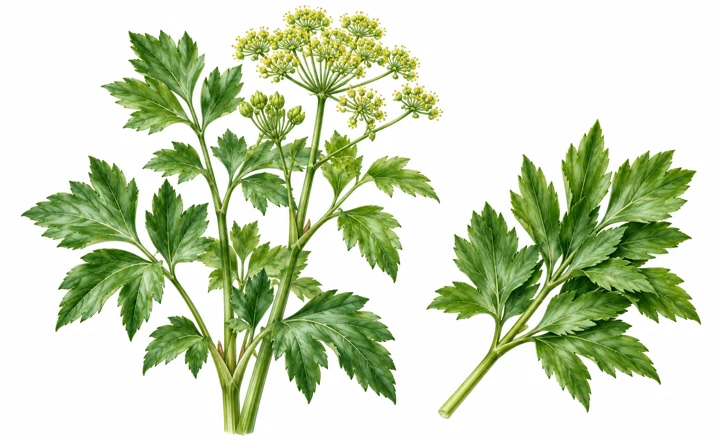
Culinary lovage is Levisticum officinale, in the carrot family, Apiaceae. The RHS plant profile describes divided green leaves, yellow-green summer flowers and a potential height around 2m with a spread up to 1m. Flowering height matters when choosing a position beside windows, paths or shorter crops.
Use labelled seed or nursery stock. A celery scent or a similar-looking leaf is not sufficient identification for eating an unfamiliar plant. This guide covers cultivated lovage, not wild foraging.
Lovage is useful for seasoning; grow celery if your main aim is a crop of substantial crisp stalks. Try a little chopped lovage in one serving of soup before adding it to the whole pan: its flavour is stronger than celery's.
Match lovage to your conditions
| Available site | Planning decision |
|---|---|
| Moist border with morning sun | Reserve a permanent position with picking access |
| Sunny bed that dries rapidly | Plan how you will check moisture during hot spells |
| Ground that stays saturated | Resolve drainage or choose a freely draining container |
| Narrow balcony | Measure the mature footprint and pot stability first |
| Mixed annual vegetable bed | Put lovage at an edge where annual digging will not disturb it |
The NC State Extension profile supports full sun to partial shade and deep, fertile, moist but well-drained soil. Our record uses four hours of direct sun as a practical partial-shade target and six as the full-sun comparison. These are planning figures, not tested minimums; use the less exposed position if your sunny site repeatedly dries out.
The record's pH range of 6.5–7.0 follows the general herb-growing target in University of Missouri Extension's guide. Lovage tolerates a wider range: the RHS profile includes acidic, neutral and alkaline soils. Test before amending pH, and prioritise drainage over chasing a narrow number.
Start from seed, a plant or division
A purchased plant is the simplest route when you only need one. The RHS growing guide recommends planting well-rooted plants in late spring or early summer, after hardening off indoor seedlings. Expect only light picking from a bought plant in its first summer; allow seed-raised plants until their second year under the RHS's cautious harvest advice.
For seed, Johnny's Selected Seeds recommends starting indoors six to eight weeks before the last spring frost, sowing about 6mm deep. Its expected germination time is 10–14 days. Pot seedlings individually at four true leaves. These are supplier guidelines, not a guarantee for an old packet or a cold windowsill; follow your packet and label the sowing date.
Johnny's gives roughly 45–60cm planting distances. For a permanent mature clump, this guide instead budgets 75–100cm between centres, based on the RHS's eventual spread. That wider allowance is an editorial choice to reduce later crowding, not a seedling-spacing requirement.
Spring division is another option, supported by the RHS profile. Use a healthy established clump, retaining roots and growing points on each piece. Do not divide a newly planted specimen simply to obtain more plants.
Can lovage grow in a pot?
Yes, although the RHS says it performs best in the ground. Use a heavy container at least 30cm wide and deep, with drainage holes and peat-free soil-based compost. Give it its own pot and plant at its previous depth. Tall stems can make a lightweight planter unstable.
The quick-reference allowance of 25 litres is our practical starting capacity, not a researched minimum. Check both width and depth: equal-volume pots can have very different shapes. Before filling, place the pot where it will be accessible for watering and where drainage will not create a nuisance. If the root ball becomes cramped, plan to repot or divide rather than assuming extra fertiliser will solve the problem.
Watering, feeding and summer cutting
The RHS recommends regular moisture during establishment, watering established plants during prolonged dry weather, and a spring compost mulch. Ground plants generally need no additional feeding. Check pots frequently; remove flower stems for a longer leaf harvest, or cut back tired foliage if summer leaf production stalls.
Build a simple routine around observation. Check below the compost surface before watering, then note whether the plant recovers. A wilting plant in wet compost calls for a drainage check, not another automatic drink. For a container, follow the potting-mix and fertiliser labels when replenishing nutrients; soil-bed advice does not specify a universal pot-feeding dose.
Flowers, seeds and winter care
Choose your harvest priority before flowering. For leaves, remove developing flower stems. For seed, leave selected stems to mature. UC Master Gardeners of Santa Clara County advises gathering seedheads as they begin browning and notes that unattended plants can self-seed. Check surrounding soil for unwanted seedlings.
Lovage becomes dormant in winter. Mark the crown's location so you do not mistake empty ground for an available planting space. The RHS profile rates it H6 under UK conditions and advises cutting back old foliage in autumn. Keep container drainage open and reassess watering as growth stops.
The record's 5°C establishment cue is a conservative planning allowance for mild planting weather, not its winter survival limit. Established crowns and unhardened seedlings should not be treated as equally frost-resistant.
Troubleshooting
| Symptom | Check | First response |
|---|---|---|
| Holes in young foliage | Slugs or snails, particularly after dark | Inspect the plant and protect vulnerable shoots |
| Blotched, drying patches within leaves | Possible celery leaf miner | Inspect affected leaves and remove damaged material |
| Repeated leaf spotting | Possible leaf disease or environmental damage | Photograph symptoms and seek identification before treating |
| Wilting with wet compost | Drainage holes, standing water, root condition | Correct drainage before adding water or feed |
| Unexpected seedlings nearby | Seedheads left to ripen | Remove seedlings while small and revise seed collection |
The RHS profile lists slugs, snails, celery leaf miner and celery leaf spot as possible problems. These symptoms are prompts to investigate, not certain diagnoses. Keep a photograph of the whole plant as well as close-ups; isolated leaf damage can be misleading. Use only treatments labelled for the edible crop and follow any harvest interval.
Harvest, cook and store
Pick young leaves regularly once the plant can support harvesting; leave enough foliage for continued growth. UC Master Gardeners recommends frequent harvesting for tender regrowth. April–September is our approximate UK leaf-harvest planning window; actual availability follows spring growth, flowering management and local weather.
Wash leaves before use. Finely chop a small amount into soup, gravy or a potato dish, then taste before adding more. Illinois Extension also describes edible stems and roots. For a leaf-focused kitchen plant, leave the crown and roots intact rather than sacrificing it for a different harvest.
For storage, Illinois Extension's preserving guidance offers two useful options:
- Dry washed, surface-dried leaves in loose bunches or a single layer somewhere airy and out of direct sun. Seal only when fully dry, then store away from heat and light.
- Freeze chopped leaves in small water-filled ice-cube trays, then transfer to labelled freezer bags. Use these portions in cooking; frozen foliage loses the appearance of a fresh garnish.
For seeds, Illinois recommends drying browning heads in ventilated paper bags and separating the seeds when dry. Keep culinary seed separate from packets intended for sowing, and label both. This guide concerns ordinary food use, not medicinal preparations.
Sources and review basis
- How to grow lovage — RHS: establishment, containers and routine care.
- Levisticum officinale — RHS: identity, mature size, hardiness, division and crop health.
- Lovage — Illinois Extension: flavour, growing conditions and kitchen use.
- Levisticum officinale — NC State Extension: light, soil and growth habit.
- Growing herbs at home — University of Missouri Extension: general herb soil-pH target.
- Lovage: key growing information — Johnny's Selected Seeds: seed depth, timing and nursery spacing.
- Lovage — UC Master Gardeners of Santa Clara County: dormancy, picking and seed management.
- Preserving herbs — Illinois Extension: drying and freezing.
Reviewed 23 September 2026. Light hours, mature spacing, pot volume, planting temperature and UK harvest months are editorial planning allowances explained above, not universal biological thresholds. The illustration is decorative, not an identification aid.