Quick answer
Sow swedes in their final bed in late spring or early summer for an autumn and winter crop. Give full-sized plants 20–25cm each, maintain moisture through dry spells and plan to keep the bed occupied for several months. A sunny site with good drainage and reliable access to water is a better fit than a hot, dry corner.
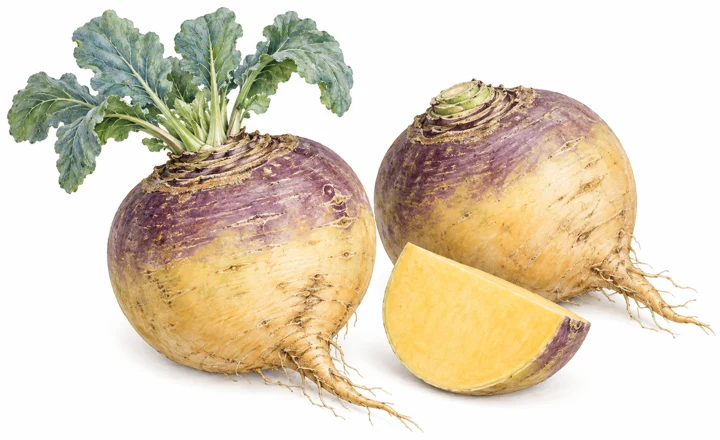
Swede and rutabaga are names for the same crop, Brassica napus Napobrassica Group. The usual yellow-fleshed roots are denser than turnips, which are better suited to a quick catch crop. Choose swedes when your priority is a substantial winter cooking vegetable.
Match the crop to your conditions
Iowa State University Extension recommends at least six hours of direct sunshine and uncompacted soil. Use a raised bed where drainage is poor. Prepare the root zone before sowing; trying to loosen it around an established crop risks damage.
| Your situation | Practical choice |
|---|---|
| Sunny bed, summer water available, autumn harvest wanted | Grow full-sized swedes |
| Only a few weeks between other crops | Choose a quicker crop such as radishes |
| Patio pot | Grow baby swedes; do not plan on storage-sized roots |
| Bed occupied by cabbage or kale last season | Find another position within the rotation |
| Hot summers | Work backwards from cooler autumn weather using the variety's maturity guidance |
Timing and seed choice
Check that the packet says swede or rutabaga: regional names such as “turnip” can be ambiguous. Choose for harvest season and keeping quality, then consider disease resistance where relevant. Compare two packets by their sowing window and maturity information, not just root colour.
Allow room in the calendar as well as the bed. Iowa State gives roughly 90–110 days to harvest, while the RHS swede guide allows up to six months. Those are regional guides, not interchangeable deadlines. For example, a late-summer gap after another vegetable may leave too little growing time for a slow cultivar.
Soil, sowing and thinning
Aim for soil pH 6–7, as advised by University of Minnesota Extension. Test before adding lime or fertiliser. Incorporate mature compost ahead of planting; avoid fresh manure. Include swedes with other brassicas in your rotation, not with unrelated root crops merely because you harvest their roots.
The RHS method is to sow thinly in watered drills about 2cm deep, with rows 38cm apart, then thin seedlings to 20–25cm. Follow the packet if its depth differs. Direct sowing is simplest; young module plants are possible if transplanted before the main taproot develops and hardened off first.
Mark the row and record the date. Inspect emergence before sowing again: a dry or crusted surface calls for attention to the seedbed, not simply more seed. Remove surplus seedlings promptly so each remaining plant has its allotted space.
Watering, feeding and routine care
Keep moisture reasonably even rather than alternating drought with heavy watering. Utah State University Extension links moisture swings with cracking, woodiness and bitter flavour. Check soil below the surface before irrigating; the appearance of the top layer alone can mislead.
Weed while plants are small, working shallowly around roots. Mulch after thinning to reduce evaporation and weed competition. Feeding should reflect a soil test and the compost already applied. Review growth a few weeks after establishment, but check moisture, crowding and pests before treating poor growth as a fertiliser shortage.
A useful weekly routine is to check the soil, inspect both sides of leaves, remove competing weeds and look for gaps in crop covers. After heavy rain, check drainage; during drying winds, check moisture more often.
Baby swedes in containers
The RHS recommends a pot at least 40cm wide, peat-free compost and 8–10cm spacing for baby roots. Full-sized swedes are better grown in the ground. Ensure drainage holes are clear and check pots frequently, since their water supply is limited.
The fact panel's 20-litre container allowance is a practical planning estimate for baby crops, not a proven minimum for mature roots. Its 10°C sowing threshold is likewise a conservative planning trigger, not a germination limit; use the seasonal guidance and seed packet as well. The 20–25cm spacing in the panel applies to full-sized plants in beds.
Diagnose problems before acting
| What you see | What to investigate | First action |
|---|---|---|
| Tiny round leaf holes | Flea beetles, especially on seedlings | Inspect young growth and crop-cover edges |
| Larger ragged holes | Caterpillars or other leaf feeders | Look beneath leaves before choosing a control |
| Root tunnels and declining growth | Root-fly larvae | Lift an affected plant to inspect the root |
| Swollen, distorted roots with wilting | Possible clubroot | Seek a diagnosis before replanting brassicas |
| Split or tough roots | Moisture fluctuations, heat or delayed harvest | Review watering and sample a root |
| Small roots in a crowded row | Competition for space | Check actual distances between plants |
Fine insect mesh is a useful preventive barrier. Keep it secured and leave growing room beneath it. Covers do not replace inspection: pests may already be present. Utah State and Minnesota Extension describe the main insect problems; identify the cause before applying a treatment.
Harvest, storage and use
Start checking roots around 10cm across; harvest size depends on the variety and intended use. Light frost can improve flavour, but do not wait for frozen ground just to meet a calendar date. Loosen roots with a fork held clear of the crop, then lift without bruising them.
Trim foliage before storage. Minnesota Extension recommends cold, very humid root-cellar conditions, about 0–4°C and 95% relative humidity. Storage can last months under suitable conditions, but a warm shed or dry refrigerator is not equivalent. Inspect stored roots regularly and separate damaged or deteriorating ones.
Lift before severe freezing or winter waterlogging makes the bed unsuitable. Where roots remain outdoors, plan access and protection in advance. Cook harvested swedes in mash, roast pieces or soups; trial a small harvest first to judge texture before lifting the whole row.
Sources and review basis
- How to grow swedes — Royal Horticultural Society: UK sowing, spacing, container crops and seasonal care.
- Growing turnips and rutabagas — University of Minnesota Extension: soil pH, rotation, root pests and storage.
- Rutabagas and turnips in the garden — Utah State University Extension: watering, cultivation and growing problems.
- Growing turnips and rutabagas in the home garden — Iowa State University Extension: light, crop comparisons, maturity and harvest.
Reviewed against these sources on 23 September 2026. Calendar guidance is UK-oriented; North American sources inform the growing principles rather than supplying universal sowing dates. Container volume and the conservative temperature trigger are editorial planning allowances, as explained above.